
We use cookies
We use essential cookies to run this site. With your permission, we'd also like to use analytics cookies to see how the site is used, and functional cookies for chat and videos. Change your choice any time under Cookie settings. Read our Cookies Policy
How it works
How SeqOps scans your cloud and servers
Read-only connections to your cloud accounts and a lightweight agent on your servers send security metadata to SeqOps. SeqOps analyses it, ranks what it finds and tells you how to fix it.

'%20d='M33.338%206.544h26.038l-27.03%2080.087a4.152%204.152%200%200%201-3.933%202.824H8.149a4.145%204.145%200%200%201-3.928-5.47L29.404%209.368a4.152%204.152%200%200%201%203.934-2.825z'/%3e%3cpath%20fill='%230078D4'%20d='M71.175%2060.261h-41.29a1.911%201.911%200%200%200-1.305%203.309l26.532%2024.764a4.171%204.171%200%200%200%202.846%201.121h23.38z'/%3e%3cpath%20fill='url(%23azure-gradient)'%20d='M33.338%206.544a4.118%204.118%200%200%200-3.943%202.879L4.252%2083.917a4.14%204.14%200%200%200%203.908%205.538h20.787a4.443%204.443%200%200%200%203.41-2.9l5.014-14.777%2017.91%2016.705a4.237%204.237%200%200%200%202.666.972h23.304l-10.12-29.194-28.807-.009%2017.955-53.707z'/%3e%3cpath%20fill='%235EA0EF'%20d='M66.595%209.364a4.145%204.145%200%200%200-3.928-2.82H33.648a4.146%204.146%200%200%201%203.928%202.82l25.184%2074.62a4.146%204.146%200%200%201-3.928%205.472h29.02a4.146%204.146%200%200%200%203.927-5.472z'/%3e%3c/svg%3e)
'%20fill='%23ea4335'/%3e%3cpath%20id='Path_5851'%20data-name='Path%205851'%20d='M50.748,25.583A30.878,30.878,0,0,0,41.44,10.576L31.82,20.2A17.1,17.1,0,0,1,38.1,33.761v1.708a8.514,8.514,0,1,1,0,17.028H20.949l-1.684,1.828v10.27l1.684,1.611H38.1A22.214,22.214,0,0,0,50.748,25.583Z'%20transform='translate(18.309%20-2.815)'%20fill='%234285f4'/%3e%3cpath%20id='Path_5852'%20data-name='Path%205852'%20d='M21.265,41.362H38.389V27.653H21.265a8.406,8.406,0,0,1-3.512-.77l-2.429.746-6.9,6.854-.6,2.333A22.222,22.222,0,0,0,21.265,41.362Z'%20transform='translate(0.873%2022.029)'%20fill='%2334a853'/%3e%3cpath%20id='Path_5853'%20data-name='Path%205853'%20d='M26.514,15A22.271,22.271,0,0,0,13.069,54.923L23,44.99A8.562,8.562,0,1,1,34.33,33.662l9.933-9.933A22.246,22.246,0,0,0,26.513,15'%20transform='translate(-4.375%203.922)'%20fill='%23fbbc05'/%3e%3c/svg%3e)
;}.g{fill:%2371b8e0;}.h{fill:%2379b9e3;}%3c/style%3e%3cclipPath%20id='a'%3e%3cpath%20class='a'%20d='M0,484.068s12.436,7.444,19.464,11.49c1.16.668,5.341,3.472,6.136,3.928a2.846,2.846,0,0,0,2.51.766L0,474.07Z'%20transform='translate(0%20-474.07)'/%3e%3c/clipPath%3e%3c/defs%3e%3cg%20transform='translate(-0.894%20-0.516)'%3e%3cpath%20class='b'%20d='M28.039,0c7.11,0,11.221.185,14.807,6.324l5.811,11c3.639,6.232,1.785,9.091-1.854,15.323L45.31,35.2c-3.585,6.14-5.458,9.686-12.568,9.686l-8.088.228c-7.11,0-11.062.174-14.647-5.965L3.4,27.945c-3.639-6.232-.822-9.151,2.817-15.383L7.749,9.909C11.334,3.769,11.961.8,19.071.8Z'%20transform='translate(0%2026.347)%20rotate(-30)'/%3e%3cpath%20class='c'%20d='M15.892,1.307A5.228,5.228,0,0,0,11.377,3.9L2.02,19.921a5.235,5.235,0,0,0,0,5.273l9.357,16.022a5.228,5.228,0,0,0,4.515,2.592H34.736a5.228,5.228,0,0,0,4.514-2.592l9.357-16.022a5.235,5.235,0,0,0,0-5.273L39.25,3.9a5.228,5.228,0,0,0-4.514-2.592H15.892m0-1.307H34.736a6.535,6.535,0,0,1,5.643,3.239l9.357,16.022a6.535,6.535,0,0,1,0,6.591L40.379,41.875a6.535,6.535,0,0,1-5.643,3.239H15.892a6.535,6.535,0,0,1-5.643-3.239L.892,25.853a6.535,6.535,0,0,1,0-6.591L10.249,3.239A6.535,6.535,0,0,1,15.892,0Z'%20transform='translate(0.894%2025.83)%20rotate(-30)'/%3e%3cpath%20class='d'%20d='M0,1926.875l14.465,8.352.022-.012L0,1926.851Z'%20transform='translate(20.165%20-1881.678)'/%3e%3cpath%20class='d'%20d='M814.065,1215.87l.125-.067-.125-.072Z'%20transform='translate(-779.509%20-1183.13)'/%3e%3cg%20transform='translate(11.763%2011.436)'%3e%3cpath%20class='e'%20d='M28.11,500.251v-9.995L8.444,478.877l-3.5-2.825L0,474.069l10.51,11.854Z'%20transform='translate(8.387%20-465.688)'/%3e%3cg%20transform='translate(8.387%208.381)'%3e%3cg%20class='f'%3e%3crect%20class='a'%20width='28.11'%20height='26.182'/%3e%3c/g%3e%3c/g%3e%3cpath%20class='c'%20d='M835.071,18.012l8.383,9.8V13.232l-12.1-7.326-1.55-.895L821.5.215l6.748,10.232Z'%20transform='translate(-798.588%20-0.211)'/%3e%3cpath%20class='g'%20d='M0,433.688l8.312,4.786,1.2-.691-7.552-5.228Z'%20transform='translate(8.387%20-425.306)'/%3e%3cpath%20class='g'%20d='M81.046,0,81.02.011,72.477,4.944l-4.75,2.742,8.312,4.786,4.718-2.724.005,0,1.546.9,8.738,5.071,3.58,2.077L81.053,0Z'%20transform='translate(-58.142%200.004)'/%3e%3cpath%20class='c'%20d='M-34.4,1334.451l22.8,13.093a102.553,102.553,0,0,0-7.044-10.592,57.33,57.33,0,0,0-7.369-7.723L-34.4,1318.82Z'%20transform='translate(34.402%20-1305.159)'/%3e%3cpath%20class='h'%20d='M1050.279,1684.65l7.839,5.093,1.7-.987-8.354-4.792Z'%20transform='translate(-1023.324%20-1654.193)'/%3e%3cpath%20class='h'%20d='M14.415,1379.833l.073.042,8.656-5,1.377-.8,2.387-1.378-8.339-4.8-2.386,1.377-1.367.789-10.4-6L0,1361.519l6.879,8.741Z'%20transform='translate(8.386%20-1337.448)'/%3e%3c/g%3e%3c/g%3e%3c/svg%3e)
Two ways in: cloud accounts and servers
Cloud accounts
Step 1: Connect read-only
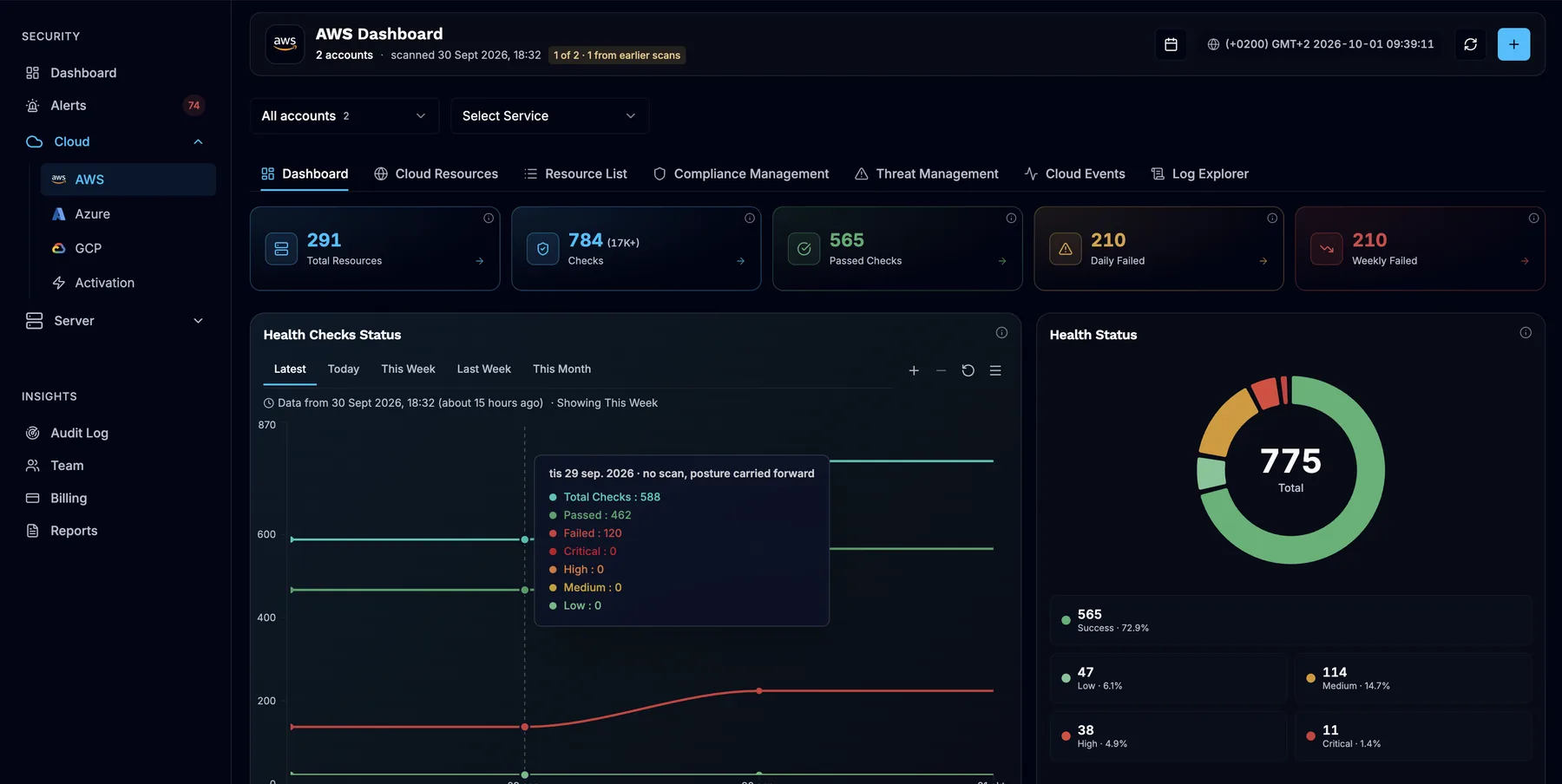
Add an AWS account, Azure subscription or Google Cloud project with read-only permissions. On AWS that’s an IAM role with the SecurityAudit and ViewOnlyAccess policies; on Google Cloud, enable the Cloud Resource Manager and Compute Engine APIs first.
Step 2: SeqOps collects configuration metadata
Settings, identities, network rules, storage and compute configuration, over an encrypted connection.
Step 3: Findings are ranked
Misconfigurations and risks are checked against security benchmarks and rated Critical, High, Medium, Low or Informational.
Step 4: You fix and track
Assign findings, follow alerts from New to Resolved, and see your compliance score change.
Step 5: Disconnect any time
Remove the account in SeqOps and delete the IAM role (or equivalent) to end access completely. Deleting an account also removes its history, so export reports first.
Servers
Step 1: Install the agent
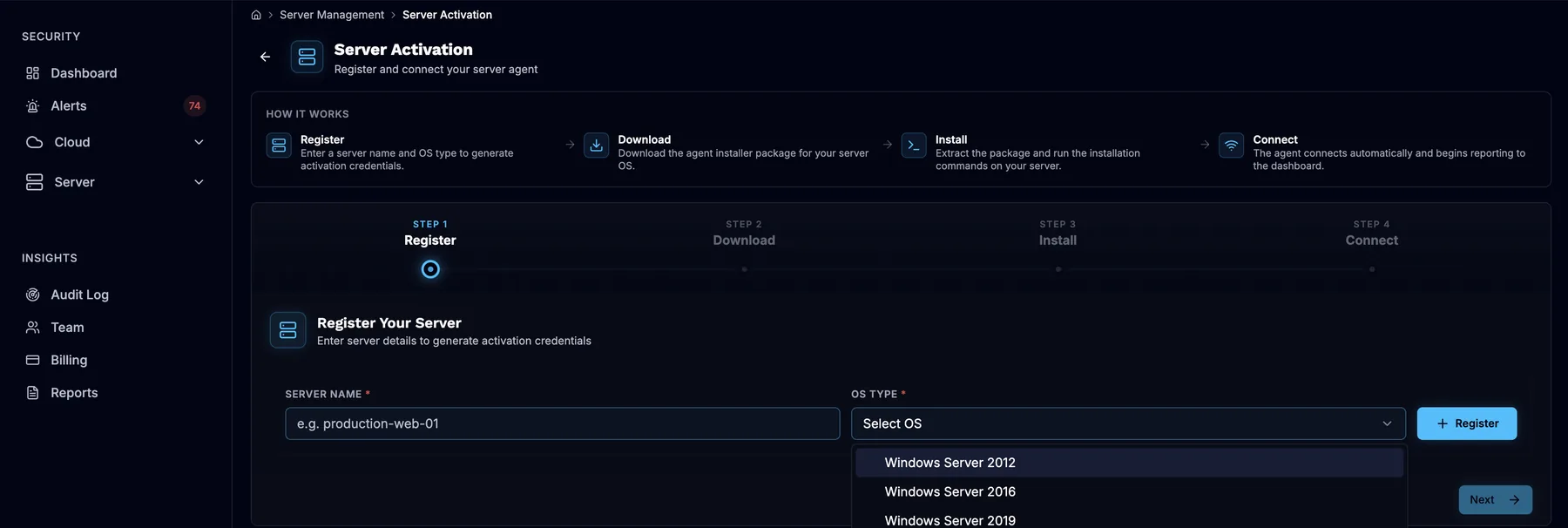
One lightweight agent per Windows or Linux server. It only makes outbound connections: HTTPS on port 443, plus port 8443 while a Windows server is being provisioned. No inbound firewall rules, and no cloud credentials on the server.
Step 2: The agent reports security metadata
Installed software and versions, configuration and security settings.
Step 3: SeqOps matches it to known vulnerabilities
Findings are linked to CVEs and ranked by severity, with remediation guidance.
Step 4: You patch and track
Assign the alert, apply the fix, and follow it from New to Resolved.
What to expect
- Today
- Connect cloud accounts and install agents.
- Within 24 hours
- First findings and compliance results.
- Every day after
- Scanning, alerts, and reports on your plan’s schedule.
What SeqOps collects, and what it doesn’t
Security metadata only, stored in AWS eu-north-1 (Stockholm) and encrypted in transit.
Collects
Configuration states, software versions, security settings, and vulnerability and compliance results.
Doesn’t collect
Your application data.
Adds to the tools you already use
Keep your endpoint protection, EDR, MDR and SIEM. SeqOps adds the missing view: which weaknesses exist across your cloud and servers, and which to fix first. Send alerts to Slack, Microsoft Teams, Jira or ServiceNow, or to anything via webhooks and the REST API.