
Can your organization afford to overlook a critical security alert buried in millions of log entries? In today’s digital landscape, threats evolve faster than many teams can track. Security Information and Event Management (SIEM) platforms act as the central nervous system for an organization’s cybersecurity posture.
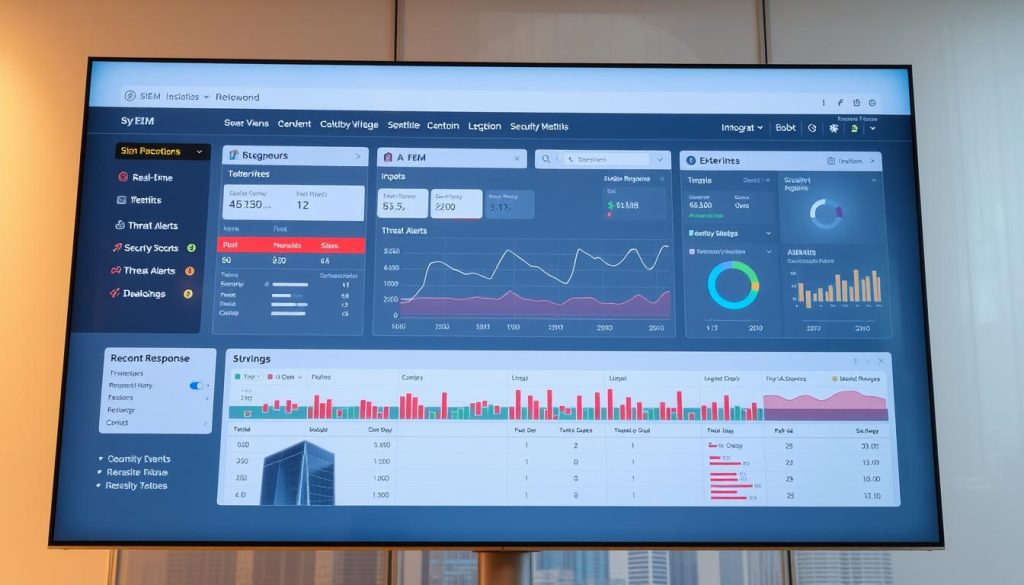
These powerful tools collect and analyze security data from across your entire infrastructure. They provide real-time visibility into potential incidents. Modern threats demand a proactive approach to detection and response.
Legacy systems often create more noise than actionable insights, draining resources. A new generation of platforms leverages automation and cloud-native architectures. They transform overwhelming data into clear, prioritized alerts.
We understand that selecting the right platform is a significant decision. Our comprehensive analysis for 2025 cuts through the complexity. We compare leading options based on deployment ease, detection breadth, and workflow efficiency.
Key Takeaways
- SIEM platforms are essential for centralized security monitoring and rapid threat response.
- Modern solutions use AI and automation to reduce alert fatigue and improve detection accuracy.
- Key evaluation criteria include ease of use, real-time analytics, and compliance reporting capabilities.
- The right tool balances powerful enterprise features with manageable operational overhead.
- Effective threat detection relies on correlating data from diverse sources across the network.
- Cloud-native architectures offer scalability and flexibility for evolving security needs.
Understanding SIEM: The Core of Security Information and Event Management
Security teams today face the challenge of managing thousands of daily security events while identifying genuine threats among routine activity. We recognize that effective security operations require centralized platforms capable of processing diverse data streams.
What is SIEM?
Security Information and Event Management represents specialized software that collects and analyzes security-related data from network devices, servers, and applications. These platforms provide foundational visibility across organizational infrastructure.
Modern solutions aggregate logs and telemetry using sophisticated correlation engines. They transform overwhelming security data into prioritized alerts through predefined detection rules.
How SIEM Helps in Threat Detection and Incident Response
These platforms excel at identifying suspicious patterns across multiple systems. Their real-time monitoring capabilities enable rapid threat detection and streamlined incident response workflows.
We emphasize three critical capabilities: comprehensive threat identification, minimized response time, and thorough investigation features. These functions work together to reduce attacker dwell time.
| SIEM Function | Primary Benefit | Business Impact |
|---|---|---|
| Log Aggregation | Centralized visibility | Unified security monitoring |
| Event Correlation | Pattern identification | Reduced false positives |
| Automated Alerting | Rapid response initiation | Minimized breach impact |
The integration of User and Entity Behavior Analytics enhances detection accuracy. This evolution makes modern platforms indispensable for Security Operations Center teams.
Key Features and Capabilities of Leading SIEM Tools
Modern cybersecurity operations demand platforms that can transform raw security data into actionable intelligence. We examine the core capabilities that distinguish effective security platforms.
Data Aggregation and Log Management
These platforms serve as sophisticated data aggregators, centralizing security logs from diverse sources. Comprehensive log management ensures complete visibility across endpoints, firewalls, and cloud systems.
Threat Detection and Behavioral Analytics
Advanced threat detection combines rule-based patterns with behavioral analytics. This dual approach identifies deviations from normal baselines, enhancing detection accuracy.
Real-time alerting features prioritize genuine threats, reducing false positives. Modern tools incorporate threat intelligence to provide context for security analysis.
Compliance and Reporting Functions
Leading platforms automate compliance reporting for standards like HIPAA and GDPR. They maintain detailed audit trails and support long-term data retention requirements.
These capabilities work together to create a robust security foundation. Effective log management and intelligent analytics form the backbone of modern security operations.
What is the best SIEM solution?
Choosing the right security platform requires careful evaluation of multiple critical factors. We guide organizations through a systematic approach to compare available options effectively.
Comparison Criteria for Top SIEM Tools
Organizations must first assess their specific security requirements and threat landscape. This foundation determines which platform capabilities will deliver the most value.
Data source compatibility forms another essential consideration. The ideal tool should monitor network logs, endpoints, cloud systems, and applications comprehensively.
Scalability ensures the platform grows with your business needs. Integration capabilities with existing security tools dramatically impact operational efficiency.
Evaluating Vendor Performance and Capabilities
Advanced analytics and machine learning features enhance threat detection accuracy. Customizable dashboards provide security teams with immediate visibility into critical events.
User interface design significantly affects adoption and response time. Intuitive platforms reduce training requirements and improve analyst productivity.
Total cost considerations extend beyond initial licensing to implementation and maintenance. Vendor support quality and compliance reporting capabilities complete the evaluation picture.
We recommend creating detailed RFPs and conducting proof-of-concept testing. This methodical approach ensures the selected solution meets both technical and operational requirements.
SIEM Solutions for Diverse Business Needs
Different business sizes and operational models demand distinct security information management strategies. We recognize that one-size-fits-all approaches fail to address the unique challenges faced by organizations across the spectrum.
Effective security platforms must adapt to organizational realities rather than forcing operational changes. This requires flexible deployment options and scalable architectures.
Balancing Enterprise and SME Requirements
Large organizations with small security teams need automated detection and response tools. These solutions help lean operations teams manage complex threat landscapes efficiently.
Small and medium enterprises require accessible platforms with predictable pricing. Managed service options provide enterprise-grade security without extensive in-house expertise.
Integration with Existing Security Infrastructure
Seamless integration maximizes the value of existing security investments. Modern SIEM platforms must connect with diverse data sources and tools.
This integration enables comprehensive correlation across cloud, on-premises, and hybrid environments. Effective data management ensures complete visibility across the entire infrastructure.
| Business Type | Primary SIEM Needs | Key Platform Features |
|---|---|---|
| Enterprise Organizations | Advanced customization, multi-site support | Scalable data processing, sophisticated analytics |
| Small/Midsize Businesses | Simplified management, cost predictability | Managed service options, intuitive interfaces |
| Managed Service Providers | Multi-tenant architecture, client isolation | Granular access control, cross-client visibility |
We emphasize that proper support and ongoing management are crucial for long-term success. The right solution balances powerful capabilities with operational practicality.
The Role of AI and Automation in Modern SIEM Platforms
Artificial intelligence has fundamentally reshaped how security teams approach threat detection and incident management. We observe that modern platforms now automate labor-intensive tasks that previously consumed analyst time.
This transformation enables security professionals to focus on strategic initiatives rather than routine data processing. The integration of machine learning creates more accurate and efficient security operations.
AI-Powered Incident Response and Threat Hunting
Advanced platforms like SentinelOne’s Purple AI function as generative cybersecurity analysts. These systems provide machine-speed analysis of emerging threats and detailed incident summaries.
AI-driven correlation techniques identify both known and unknown threats while reducing false positives. Autonomous investigation agents conduct multi-stage analysis across systems and timeframes.
Streamlining Security Operations with Automation
Security Orchestration, Automation, and Response capabilities execute complex procedures consistently. Dynamic playbooks reduce response times from hours to minutes while eliminating human error.
Platforms like Hunters leverage AI assistants to provide clear detection logic explanations. This enables faster, more confident decision-making during critical security incidents.
We emphasize that AI augments human expertise rather than replacing security analysts. This collaboration handles routine tasks at machine speed while professionals focus on complex investigation and threat hunting.
Expert Reviews and User Testimonials on SIEM Tools
Real-world experiences from security professionals provide invaluable insights into SIEM platform performance. We analyze authentic feedback to identify patterns in user satisfaction and operational effectiveness.
Insights from Security Professionals
Security teams consistently praise platforms with lightweight consoles and rapid agent updates. SentinelOne users highlight how quickly updates complete compared to legacy tools they previously used.
This platform earned Leader status in Gartner’s Magic Quadrant for Endpoint Protection. It achieved record-breaking MITRE ATT&CK results with 100% threat detection coverage.
Kyber Security leveraged ConnectWise SIEM to unify visibility across client environments. The solution helped their SOC team address critical alerts efficiently while scaling operations.
Customer Success Stories and Feedback
Organizations frequently report challenges with noisy user behavior analytics rules. Some SIEM tools generate excessive false positives that require constant tuning.
Effective correlation capabilities remain crucial for reducing manual effort. Security professionals emphasize support quality and regular content updates as differentiators.
| SIEM Platform | User-Rated Strengths | Common Challenges |
|---|---|---|
| SentinelOne | Lightweight deployment, rapid updates | Advanced features require training |
| ConnectWise | Multi-tenant visibility, alert management | Initial configuration complexity |
| Legacy Solutions | Familiar interface | Noisy alerts, outdated correlation |
We recommend consulting G2, Gartner Peer Insights, and PeerSpot for comprehensive user feedback. These platforms offer detailed ratings based on real-world deployment experiences across industries.
Strong vendor support and responsive service teams significantly impact security outcomes. Customer testimonials consistently highlight how these factors maximize investment value and accelerate incident response.
SIEM Tools for MSPs: Enhancing Multi-Tenant Security
Managed service providers operate in a uniquely demanding security landscape where client protection becomes paramount. These environments require specialized SIEM tools designed for multi-tenant architectures that maintain strict data isolation.
We emphasize that effective security platforms for MSPs must deliver centralized visibility across diverse client environments without compromising separation. The Federal Cybersecurity and Infrastructure Security Agency recognizes these platforms as essential for defending managed service environments.
Key Considerations for Managed Service Providers
Scalable deployment capabilities ensure management efficiency as client bases grow. Predictable pricing models support profitable service delivery while maintaining comprehensive threat detection.
Seamless integration with diverse client technology stacks maximizes existing security investments. Automation capabilities enhance operational efficiency for resource-constrained teams.
Top SIEM Options for MSP Environments
ConnectWise SIEM delivers purpose-built monitoring with environment-specific detections and SOAR-powered automation. Its flexible editions offer transparent per-user pricing rather than volume-based costs.
Leading alternatives provide distinct advantages for various MSP needs:
- Adlumin: Combines threat detection with user analytics and compliance reporting
- Blackpoint: Offers 24/7 human-led SOC coverage with integrated compliance logging
- Blumira: Features rapid deployment with bundled SIEM and XDR capabilities
- SentinelOne Purple AI: Delivers advanced AI-driven automation for complex threats
These platforms enable MSPs to provide continuous security monitoring and rapid incident response across all client environments. Effective log management and real-time alerting form the foundation of robust multi-tenant protection.
Emerging Trends in SIEM for 2025 and Beyond
Tomorrow’s security platforms must address evolving attack methodologies with greater intelligence. We observe significant architectural shifts transforming how organizations approach threat detection and incident management.
Cloud-Native Architectures and Scalability
Cloud-native platforms deliver elastic scalability that traditional systems cannot match. These architectures handle massive log volumes with lightning-fast search capabilities.
Bring-your-own-data-lake models provide cost-effective data management. Organizations maintain control over security data while leveraging advanced analytics.
Advancements in Behavioral Analytics and Threat Intelligence
Detection-as-code approaches enable custom rule development using programming languages. Security teams version-control detection content using DevSecOps methodologies.
Behavioral analytics establish normal user and entity behavior baselines. Machine learning algorithms identify subtle anomalies indicating advanced threats.
Platforms increasingly integrate comprehensive threat intelligence feeds. This provides real-time context about emerging attack campaigns and adversary tactics.
We see convergence between SIEM and SOAR capabilities streamlining security operations. Graph-based correlation detects complex attack chains across multiple systems.
Agentic AI systems conduct autonomous multi-stage investigations. These agents gather context and present findings for human validation.
Conclusion
Navigating the complex landscape of security platforms requires a strategic approach that balances technical capabilities with operational realities. We emphasize that selecting the right platform represents a mission-critical decision for any organization’s security posture.
We recommend a systematic evaluation process that includes detailed RFPs and hands-on proof-of-concept testing. This approach reveals how each platform performs with your specific data sources and integrates with existing infrastructure.
The optimal choice must align with your organization’s unique requirements, risk tolerance, and compliance obligations. Advanced analytics and reporting capabilities should empower your security teams to respond to incidents confidently.
We remain committed to helping organizations make informed decisions that strengthen their security operations. Thorough research and careful consideration will lead to solutions that protect valuable assets effectively.
FAQ
What is Security Information and Event Management (SIEM)?
Security Information and Event Management (SIEM) is a comprehensive security solution that combines two functions: Security Information Management (SIM) and Security Event Management (SEM). It provides a centralized platform for collecting, analyzing, and reporting on security data from across an organization’s network, systems, and applications. This enables real-time monitoring and historical analysis for improved threat detection and incident response.
How does a SIEM platform enhance threat detection and incident response?
A SIEM platform enhances threat detection by correlating security events from multiple sources using advanced analytics and detection rules. This allows security teams to identify complex attack patterns that single-point solutions might miss. For incident response, it provides the context and forensic data needed for rapid investigation and remediation, significantly reducing the time to contain threats.
What are the key capabilities to look for in modern SIEM tools?
Leading SIEM tools should offer robust data aggregation and log management, advanced threat detection with behavioral analytics, and comprehensive compliance reporting. Essential features include real-time alerting, user and entity behavior analytics (UEBA), seamless integration with other security systems, and automated response capabilities to streamline security operations.
What criteria should we use to evaluate the best SIEM solution for our business?
When evaluating SIEM solutions, consider your organization’s specific needs. Key criteria include scalability to handle your data volume, the platform’s detection and response capabilities, total cost of ownership, ease of use for your security teams, and the quality of vendor support. Evaluating vendor performance through proof-of-concept testing is also critical.
How do SIEM solutions cater to different business sizes, like enterprises versus SMEs?
Modern SIEM solutions are designed with flexibility to meet diverse needs. Enterprise-grade platforms like Splunk or IBM QRadar offer extensive scalability and advanced features for large, complex environments. For small to medium businesses (SMEs), solutions like ManageEngine Log360 or AlienVault USM provide essential log management and threat detection at a more manageable scale and cost.
What is the role of AI and automation in next-generation SIEM platforms?
Artificial intelligence and machine learning are transforming SIEM platforms by enabling proactive threat hunting and automating incident response. AI-powered analytics can identify subtle anomalies indicative of a threat, reducing false positives. Automation streamlines repetitive tasks, allowing security analysts to focus on critical investigations and improving overall operational efficiency.
Are there specific SIEM tools recommended for Managed Service Providers (MSPs)?
Yes, MSPs require SIEM tools with strong multi-tenant capabilities, centralized management, and scalable pricing. Platforms like Arctic Wolf Managed Detection and Response or ConnectWise SIEM are built to support MSPs, offering features that allow for efficient management of multiple client environments from a single console while maintaining data isolation.
What emerging trends are shaping the future of SIEM technology?
Key trends include the shift to cloud-native SIEM architectures for greater scalability and flexibility, such as Microsoft Sentinel. We also see advancements in integrating richer threat intelligence feeds and the expansion of User and Entity Behavior Analytics (UEBA) to provide deeper context for detecting insider threats and sophisticated attacks.