Is your organization’s most valuable asset truly protected in today’s digital landscape? Many businesses operate under the assumption that moving to a major platform automatically guarantees safety, but the reality of modern threats demands a more nuanced approach.
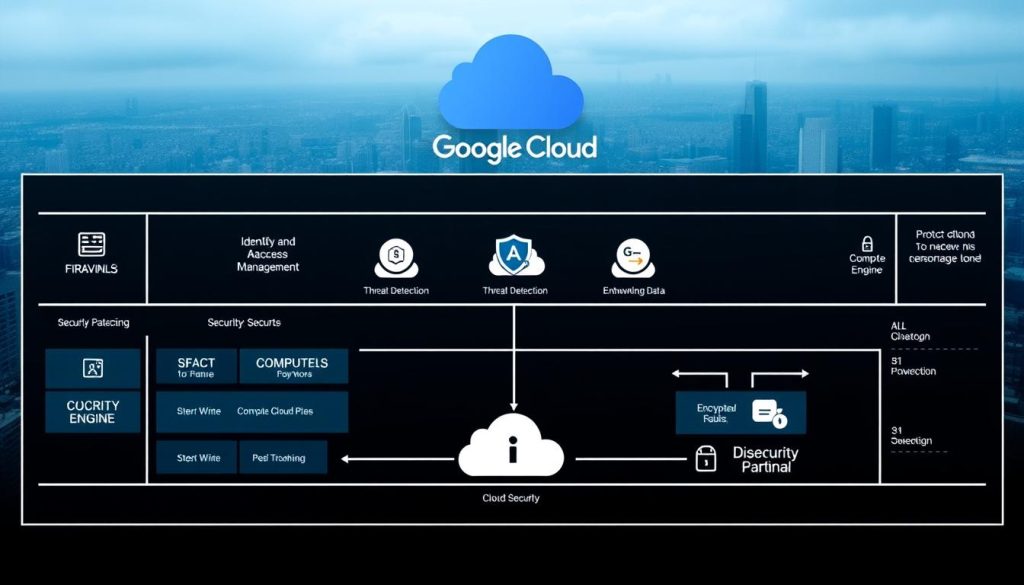
We introduce you to the comprehensive framework designed to protect enterprises operating within the Google Cloud Platform. This environment safeguards against evolving cyber threats and vulnerabilities. Understanding this protection is not just a technical necessity; it is a strategic business imperative.
As organizations increasingly migrate critical workloads, the complexity of securing distributed environments grows. It demands both technical expertise and strategic planning to maintain robust protection. Our guide establishes the foundation for understanding how this platform implements safeguards at every layer.
This ranges from physical infrastructure protection to application-level controls for your most sensitive business information. We empower decision-makers and IT professionals with actionable insights into the architecture. This knowledge helps you navigate the shared responsibility model and implement controls aligned with your organization’s risk tolerance.
Key Takeaways
- GCP provides a multi-layered security framework protecting infrastructure, applications, and data.
- A clear understanding of the shared responsibility model is crucial for effective protection.
- Security in this environment requires continuous monitoring and proactive threat detection.
- Proper implementation balances robust safety measures with business agility and innovation.
- Identity and access management form the cornerstone of a strong security posture.
- Encryption and compliance features are built into the platform’s core services.
- Strategic planning is essential to align security controls with organizational risk tolerance.
Understanding the Importance of GCP Cloud Security
Modern enterprises operate in an environment where data flows across multiple platforms, demanding new approaches to digital safeguarding. The traditional network perimeter has dissolved as organizations adopt services to enhance flexibility and support distributed workforces. This transformation creates new challenges that require comprehensive protection strategies.
We recognize that businesses generate unprecedented volumes of sensitive information requiring robust protection. This includes customer details, financial records, intellectual property, and behavioral analytics. Proper data protection within Google Cloud prevents unauthorized access to personal information and business assets.
Compliance requirements represent a critical driver for implementing strong safeguards. Different industries must adhere to specific regulations such as HIPAA for healthcare or GDPR for European Union citizens. The platform offers features designed to assist organizations in meeting these mandated standards effectively.
Advanced monitoring systems analyze network traffic and user behavior to identify anomalies in real-time. This enables proactive threat mitigation and rapid response to potential incidents. These capabilities help maintain organizational integrity across distributed environments.
The importance of this framework extends to preventing costly attacks that can disrupt operations and damage reputation. Proper implementation balances robust safety measures with business agility, ensuring long-term viability in today’s digital landscape.
Foundations of Google Cloud Platform Security
The effectiveness of any platform’s protection framework depends on properly delineated roles between infrastructure provider and user. We explain how the shared responsibility model forms the bedrock of Google Cloud Platform security. This framework clearly divides protection duties between Google and customer organizations.
Under this arrangement, Google maintains accountability for safeguarding the underlying infrastructure. This includes physical data centers, network architecture, and foundational services. Customers bear responsibility for securing their specific resources, workloads, applications, and information.
Google’s infrastructure protection operates on secure by design principles. Security considerations embed directly into physical and operational aspects of data centers. This creates a robust foundation that defends against infrastructure-level threats automatically.
The platform implements continuous automated measures without requiring customer intervention. These include encryption of data at rest and in transit, secure disposal procedures, and protected internet communication. Understanding this division prevents coverage gaps that could expose vulnerabilities.
We guide organizations to recognize their specific protection duties within this model. While Google secures the infrastructure itself, customers must manage configurations, access controls, and application code. This joint effort achieves comprehensive safety aligned with organizational risk requirements.
Getting Started with Google Cloud Security
Establishing a robust foundation begins with proper initial configuration of your Google Cloud environment. We guide organizations through account creation and project setup that establishes secure foundations for all subsequent implementations.
The Google Cloud Platform organizes assets through a hierarchical structure of Organization, Folders, Projects, and Resources. This framework enables granular policy application and access management across different levels.
We recommend immediately enabling two-factor authentication for your Google account. This essential layer significantly reduces unauthorized access risks even if credentials become compromised.
Service accounts require careful management with our best practice approach. We assign only minimum necessary permissions following the principle of least privilege for applications interacting with platform services.
| Initial Setup Step | Security Benefit | Implementation Time |
|---|---|---|
| Project Configuration | Establishes isolated environment | 5-10 minutes |
| VPC Firewall Rules | Controls network traffic flow | 15-20 minutes |
| IAM Permission Review | Reduces attack surface | 30-60 minutes |
| Billing Alerts Setup | Detects anomalous activity | 5 minutes |
Regular permission audits through IAM administration help identify excessive access rights and orphaned accounts. This proactive approach prevents permission creep that expands vulnerability exposure over time.
We ensure sensitive data receives encryption protection using built-in options for data at rest and in transit. Configuring billing alerts early serves as both cost control and anomaly detection mechanism.
Implementing the Shared Responsibility Model in GCP
The foundation of secure cloud operations rests on properly understanding who protects what. We guide organizations through implementing the shared responsibility model that defines protection duties between Google and your team. This framework varies based on your service consumption approach.
Three distinct arrangements exist within this framework. Software-as-a-Service (SaaS) or serverless options place most infrastructure management with Google. Platform-as-a-Service (PaaS) involves shared operational duties. Infrastructure-as-a-Service (IaaS) gives customers greater control and responsibility.
Google consistently maintains protection of the underlying infrastructure across all models. This includes physical data centers, network architecture, and core services. Your organization bears responsibility for securing applications, data, and access controls regardless of partnership type.
In IaaS arrangements, additional duties include protecting operating systems and databases. This requires expertise in system hardening and patch management. Proper configuration of identity controls and encryption remains essential across all models.
Failure to implement this responsibility model correctly can lead to severe consequences. These include financial losses, regulatory penalties, and reputational damage. We help document specific duties to ensure no protection gaps exist between provider and customer responsibilities.
Understanding this division helps right-size your protection investments. Focus resources on controls within your responsibility sphere while leveraging Google’s infrastructure safeguards. This approach prevents redundant spending while maintaining comprehensive safety.
Enhancing Identity and Access Management (IAM) in GCP
Identity and access management establishes the first line of defense in any digital environment. We position this framework as the critical foundation that determines who can access your resources and what actions they can perform.
Google Cloud IAM provides a comprehensive structure through three core components. These include identities like users and service accounts, the protected resources themselves, and roles defining permissible actions.
We implement the principle of least privilege as a fundamental practice. This ensures accounts receive only minimum necessary permissions to perform job functions. Such limitation reduces potential damage from compromised credentials.
Service accounts require particularly careful management. These special identities enable applications and virtual machines to interact with platform services. Regular access reviews and key rotation prevent unauthorized entry points.
Multi-factor authentication adds an essential verification layer across all user accounts. This protection works even when passwords become compromised through theft or phishing attempts.
Regular audits of IAM policies help detect anomalies like permission creep and orphaned accounts. The Orca 2024 report reveals 72% of organizations have unused roles that attackers could exploit.
We leverage advanced insights to identify and mitigate identity access risks quickly. Periodic evaluations ensure permissions align with current responsibilities, removing access for departed employees and role-changed users.
Optimizing Cloud Security Best Practices for Google Cloud
Effective protection strategies extend beyond technical controls to encompass organizational processes and human factors. We establish comprehensive approaches that combine multiple layers of defense. This addresses the constantly evolving threat landscape facing modern digital environments.
Training programs significantly reduce breach likelihood by ensuring team members understand current threats. Security awareness helps personnel effectively implement established frameworks and blueprints. These educational initiatives form the foundation of a robust security posture.
We leverage pre-configured templates to create solid foundations for implementation. These blueprints help maintain environments according to established standards and industry benchmarks. They provide structured starting points for organizations building their protection frameworks.
Our approach includes several critical components for optimal results:
- Granular access controls that minimize unauthorized access risks while optimizing resource usage
- Least privilege principles that limit permissions to essential functions only
- Centralized monitoring tools that track events across diverse services
- Built-in encryption mechanisms that safeguard information in transit and at rest
- Regular audits that identify vulnerabilities and support compliance requirements
Automation enables efficient deployment and scaling of protective measures. This creates dynamic defenses that adapt to changing conditions. Virtual Private Cloud implementations provide additional network-level controls through firewall rules.
Continuous improvement cycles ensure defenses remain aligned with organizational objectives. Regular evaluations identify areas requiring enhancement while maintaining regulatory alignment. This comprehensive approach delivers sustainable protection for business-critical assets.
Leveraging Google Cloud Security Tools and Services
Organizations gain significant advantages by leveraging Google’s native security services for threat detection and prevention. We implement these integrated solutions to create comprehensive protection frameworks. This approach ensures seamless operation across your entire digital infrastructure.
Key Security Services in GCP
Google’s platform offers specialized tools that address specific protection needs. The Cloud Key Management Service provides centralized control over encryption keys. This ensures regulatory compliance while maintaining data confidentiality.
Virtual Private Cloud delivers robust networking functionalities with granular configuration options. We establish secure connections between resources while controlling network access. This creates isolated environments for sensitive workloads.
Cloud Armor defends against sophisticated web attacks and DDoS attempts. The service analyzes traffic patterns to identify malicious behavior. This prevents service disruptions from volumetric attacks.
| Security Tool | Primary Function | Integration Level |
|---|---|---|
| Cloud KMS | Encryption key management | Native platform integration |
| Virtual Private Cloud | Network isolation and control | Infrastructure-level integration |
| Cloud Armor | DDoS and web attack protection | Application-level integration |
| Audit Logging | Activity monitoring and analysis | Cross-service integration |
Real-Time Threat Detection and Monitoring
Continuous monitoring capabilities provide immediate visibility into potential threats. We analyze three critical audit log types: Admin Activity, System Event, and Data Access. These logs offer comprehensive insight into platform operations.
Security scanning tools automatically assess applications for vulnerabilities. They identify common weaknesses in web applications running across different environments. This proactive approach prevents exploitation attempts.
Real-time analysis detects anomalies in network traffic and user behavior. The system identifies indicators of compromise before they escalate. This enables rapid response to emerging threats.
We integrate these capabilities into cohesive protection strategies. Each service contributes to overall visibility while maintaining operational efficiency. This creates sustainable defense mechanisms for business-critical assets.
Deep Dive into Google SecOps and the Security Command Center
Operational integration between protection teams and IT departments creates a unified defense approach. We implement Google SecOps to embed safety considerations throughout operational processes. This collaboration ensures rapid response capabilities across your entire digital infrastructure.
Overview of the Security Command Center
The Security Command Center serves as a centralized dashboard for comprehensive visibility. It provides real-time insights into asset inventory and potential vulnerabilities. This unified tool streamlines management of your protection posture.
We leverage automated scanning to identify weaknesses across diverse resources. The system offers recommended remediation actions for accelerated resolution. Custom tagging capabilities help prioritize findings based on business impact.
| Capability | Primary Function | Business Benefit |
|---|---|---|
| Asset Inventory | Comprehensive resource visibility | Rapid risk identification |
| Threat Detection | Real-time anomaly analysis | Proactive threat mitigation |
| Compliance Reporting | Regulatory standard assessment | Streamlined audit processes |
| Security Marks | Custom finding categorization | Prioritized response efforts |
Effective Incident Response Strategies
We configure custom alerts for immediate notification of critical issues. This enables proactive threat hunting and accelerated response workflows. Real-time dashboards provide continuous monitoring capabilities.
Regular security reviews identify trends and assess control effectiveness. These evaluations inform continuous improvement of your protection posture. The integration ensures sustainable defense mechanisms for business-critical assets.
Advanced Security Techniques in the Google Cloud Environment
Sophisticated protection strategies move beyond basic configurations to create layered defenses within your digital infrastructure. We implement advanced network segmentation that partitions your environment into isolated zones with distinct policies. This approach contains potential breaches and limits lateral movement opportunities.
Granular controls through firewall rules manage traffic flow at the instance level. We restrict access to sensitive resources based on source, destination, and protocol specifications. Private IP configuration prevents direct exposure to external threats.
Our testing methodology includes vulnerability assessments using automated scanning tools. These continuously evaluate resources and applications for known weaknesses. Penetration testing goes further by emulating real-world attack scenarios.
Security code review analyzes both application source code and infrastructure configurations. This detects flaws before deployment. Comprehensive configuration reviews ensure proper implementation of controls.
Threat modeling identifies potential attack vectors by analyzing system design and vulnerabilities. Compliance audits verify adherence to industry regulations like HIPAA and GDPR. These techniques collectively strengthen your organizational posture.
Leveraging Automation and AI for GCP Security
AI-driven capabilities are revolutionizing the way professionals interact with and manage their digital infrastructure. We implement intelligent automation to create dynamic protection postures that adapt to changing conditions. This approach integrates seamlessly into broader organizational strategies.
Automation handles routine tasks, saving teams valuable time and capacity. This allows focus on strategic initiatives and complex threat investigations. Manual operational activities become streamlined through predefined workflows.
AI-Driven Security Insights
Natural language processing transforms how users search their Google Cloud assets. Instead of complex query languages, professionals ask questions in plain English. These AI-powered features compensate for knowledge deficits across teams.
According to the Orca 2024 report, 62% of organizations have deployed AI packages with vulnerabilities. Despite this risk, AI continues to help overcome shortages of time and resources. The technology serves as a force multiplier for smaller teams.
Automated Compliance and Monitoring Tools
Continuous assessment against regulatory frameworks happens in real-time. Automated monitoring identifies deviations before they become compliance violations. This proactive approach prevents penalties and audit findings.
Remediation capabilities generate high-quality code tailored to specific tools. Even teams lacking deep expertise can effectively address issues. These services create sustainable protection mechanisms for business-critical applications.
Ensuring Data Protection and Encryption in GCP
Modern data protection strategies center around comprehensive encryption frameworks that render sensitive information useless to attackers. We implement layered approaches that safeguard business assets throughout their entire lifecycle within the Google environment.
The platform automatically applies powerful encryption technology to data at rest and in transit. This baseline protection operates without requiring customer configuration, ensuring continuous safety.
We leverage Google Cloud Key Management Service for centralized cryptographic control. Organizations maintain custody over symmetric or asymmetric keys used for encryption operations. This governance model meets regulatory requirements for key custody.
Customer-managed encryption keys provide additional control over the encryption process. Organizations can manage their own key lifecycle including creation, rotation, and destruction. This approach supports specific compliance needs.
| Encryption Type | Protection Method | Key Benefit |
|---|---|---|
| Data at Rest | Automatic storage encryption | Persistent protection |
| Data in Transit | SSL/TLS protocols | Secure transmission |
| Customer-Managed Keys | Custom key lifecycle | Enhanced control |
| Service Integration | Native platform features | Seamless operation |
Data in transit receives protection through established SSL and TLS protocols. These create encrypted communication channels between clients and Google services. This prevents interception during network transmission.
Regular rotation of encryption keys represents a critical practice we implement. Automated capabilities reduce operational burden while maintaining effectiveness. This approach limits exposure windows if keys become compromised.
We recognize that encryption alone provides incomplete protection. Proper key management, access controls, and audit logging form essential components of comprehensive data safety strategies.
Addressing Common Security Challenges in Google Cloud
Organizations face numerous protection challenges when operating in the Google Cloud environment. We help businesses identify and mitigate these risks before they impact operations.
Recent research shows misconfigurations rank as the top risk executives identify. Configuration errors in cloud resources can expose sensitive data and create broad access permissions.
Managing Misconfigurations and Vulnerabilities
Vulnerabilities introduced by third-party software present persistent challenges. Security teams typically address only 10% of detected weaknesses monthly due to volume constraints.
Sensitive data exposure occurs when storage buckets and databases receive improper settings. This leaves personal information and intellectual property accessible to unauthorized parties.
We implement comprehensive scanning for vulnerable container images deployed on Compute Engine. These weaknesses can compromise applications and enable privilege escalation.
Resolving Identity and Access Risks
Identity and access risks include improper controls and orphaned roles. The Orca 2024 report reveals 72% of organizations have unused IAM roles.
Insecure APIs represent significant vulnerabilities with inadequate access controls. Attackers can exploit these to compromise cloud resources and infrastructure.
We address insider threats through robust monitoring and prompt credential revocation. Traditional threats like phishing and DDoS attacks also require comprehensive defense strategies.
Scaling organizations struggle to maintain visibility across all their resources. Centralized management becomes essential for consistent protection practices.
Integrating Third-Party Solutions with GCP Security
The integration of external security platforms can significantly enhance an organization’s defensive posture within the Google Cloud environment. We recognize that specialized solutions provide advanced capabilities beyond native offerings.
Enhancing Encryption and Compliance with SentinelOne
SentinelOne’s Singularity Platform extends protection for workloads running in Google Cloud. The platform safeguards business information through robust measures.
We leverage advanced analytics engines to examine workload telemetry rapidly. This empowers teams to investigate stealth attacks across multiple surfaces.
| Integration Feature | Google Cloud Native | SentinelOne Enhanced |
|---|---|---|
| Workload Protection | Basic monitoring | Advanced threat detection |
| Data Encryption | Standard protocols | Enhanced key management |
| Compliance Automation | Framework support | Automated validation |
| Identity Risk Analysis | Basic IAM controls | AI-driven insights |
Log data transfers seamlessly using Pub/Sub integration for detailed analysis. This provides deeper insights into events across your environment.
AI-driven capabilities identify identity management risks quickly. The system detects anomalous patterns and highlights excessive permissions.
Encryption services protect stored information while securing data in transit. Management integrates smoothly with native Google Cloud features.
Compliance frameworks including GDPR and HIPAA become more achievable through automation. This helps organizations meet regulatory requirements effectively.
Building a Secure Cloud Environment with Google Cloud
As organizations expand their digital footprint across hybrid architectures, comprehensive protection strategies become essential for maintaining operational integrity. We guide teams through establishing resilient frameworks that address multi-platform complexities.
Strong identity controls form the foundation of any protected operational space. These mechanisms determine who can access specific assets and what actions they can perform. Continuous monitoring identifies configuration issues that might enable unauthorized movement.
| Protection Component | Implementation Focus | Business Benefit |
|---|---|---|
| Network Segmentation | Isolated security zones | Limited breach impact |
| Regular Evaluations | Continuous validation | Proactive risk mitigation |
| Stakeholder Collaboration | Cross-team alignment | Clear responsibility definition |
| Default Policies | SSL encryption | Automated protection |

Google’s platform benefits from extensive research expertise. The company maintains a team of over 700 specialists who discovered critical vulnerabilities. Reward programs encourage responsible disclosure of software issues.
Building a protected operational space requires balancing safety requirements with business agility. Proper implementation safeguards assets without impeding development velocity. This approach maintains competitive advantage while ensuring comprehensive protection.
Conclusion
The journey toward robust digital protection represents an ongoing process rather than a final destination. We have guided you through the comprehensive landscape of safeguards available within the Google Cloud Platform, from foundational concepts to advanced techniques.
Effective protection requires integrating native tools with organizational processes and third-party solutions. Regular evaluations and stakeholder collaboration enhance your overall posture while improving visibility across all resources.
According to Gartner research, CNAPP technology plays a crucial role in achieving zero-trust objectives. Organizations that neglect these advanced platforms risk falling behind in their protection goals by 2029.
We encourage immediate action on the guidance provided, starting with quick wins while planning longer-term initiatives. This balanced approach ensures your organization can confidently leverage platform capabilities while maintaining integrity.
The commitment to implementing best practices and adapting to evolving threats positions businesses for sustainable success in today’s digital environment.
FAQ
What is the shared responsibility model in Google Cloud Platform?
The shared responsibility model defines security obligations between Google and the customer. Google secures the underlying infrastructure, including hardware and global network. Customers are responsible for securing their data, access management, and application configurations within the platform.
How does Identity and Access Management (IAM) help protect my resources?
Identity and Access Management provides granular control over who can access specific services and resources. By following the principle of least privilege, you grant users only the permissions they absolutely need, significantly reducing the risk of unauthorized access to sensitive information.
What tools are available for monitoring threats in my environment?
The Security Command Center offers comprehensive threat detection, vulnerability scanning, and compliance monitoring. It provides a centralized dashboard to view your security posture, identify risks, and receive actionable recommendations for remediation across your entire infrastructure.
How can I ensure my data is encrypted both at rest and in transit?
Google Cloud Platform provides default encryption for data at rest and supports industry-standard protocols for data in transit. You can use Cloud Key Management Service to manage your own encryption keys, adding an extra layer of control for meeting strict compliance requirements.
What are the best practices for securing a virtual private cloud network?
Implement firewall rules that restrict traffic to necessary ports and protocols. Use private Google access for virtual machines without external IP addresses and configure route tables to control traffic flow. Regularly audit these configurations to maintain a strong network security posture.
How does automation improve security in a cloud environment?
Automation enables continuous compliance checks and real-time response to threats. You can set up policies that automatically remediate common misconfigurations and receive AI-driven insights to proactively address potential vulnerabilities before they can be exploited.