
A staggering 68% of business leaders feel their organization’s cybersecurity measures lag behind evolving digital dangers. This gap leaves critical operations exposed to potential disruptions.
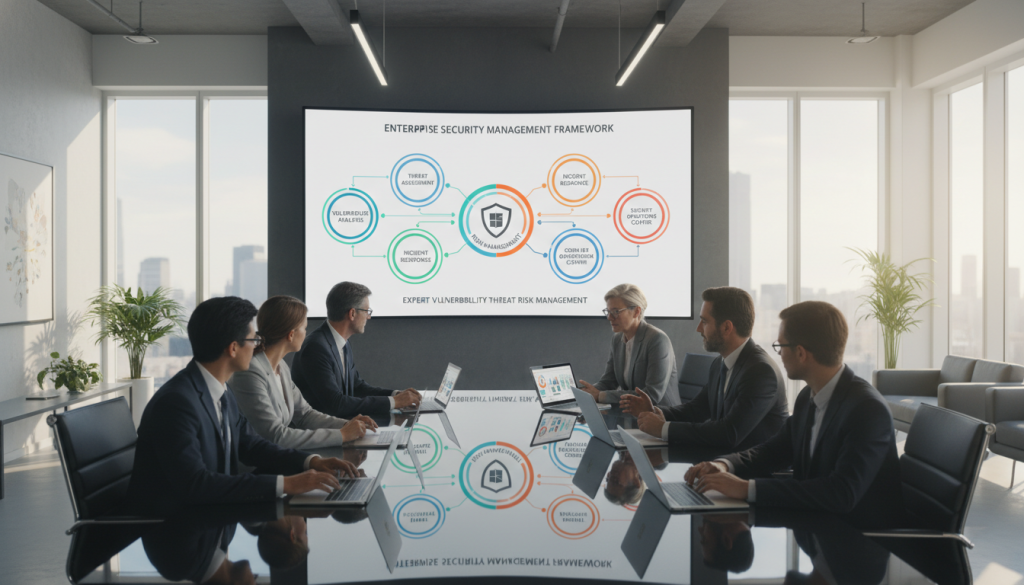
We understand that modern enterprises face sophisticated challenges in protecting their digital infrastructure. The landscape requires a comprehensive approach that connects various security elements.
Our expertise helps organizations move beyond reactive measures. We empower businesses with proactive, intelligence-driven strategies that anticipate potential problems before they become serious issues.
Effective enterprise protection depends on clearly understanding different security components. These include weaknesses in defenses, potential exploiters, and the likelihood of actual damage occurring.
This guide walks you through foundational concepts and practical frameworks. We’ll show proven strategies that build resilient security postures capable of withstanding modern digital challenges.
Key Takeaways
- Most organizations struggle to keep pace with evolving cybersecurity challenges
- Proactive strategies outperform reactive security measures
- Understanding security components separately creates stronger protection
- Business continuity depends on effective security management
- Collaborative approaches bridge technical and business perspectives
- Prioritization is essential for managing multiple security concerns
- Resilient security postures withstand modern digital threats
Understanding Cybersecurity Basics: Vulnerabilities, Threats, and Risks
Building a resilient cybersecurity posture begins with mastering fundamental terminology. We establish a clear framework for understanding the cybersecurity where distinct concepts interact systematically.
Defining the Cybersecurity Spectrum
Security weaknesses in people, processes, or technology create potential entry points. These gaps only become problematic when external forces target them.
Malicious actors or events represent the active components in this equation. They seek to exploit existing weaknesses for harmful purposes.
The potential for damage emerges when exploitation occurs. This potential is measured by both likelihood and impact assessment.
The Role of Assets in Enterprise Security
Everything of value constitutes your organization’s protected items. These include personnel, digital infrastructure, and sensitive information.
We help businesses recognize that effective protection requires understanding complex interactions. Clear definitions enable better communication between technical and business teams.
This foundational knowledge transforms how organizations prioritize security investments. It creates alignment between protection measures and business objectives.
What is a Vulnerability in Cybersecurity?
We begin our deep dive by examining the static weaknesses that form the foundation of security concerns. These flaws are shortcomings in a system, process, or control that create potential openings.
They exist regardless of whether someone is actively trying to exploit them. Recognizing these gaps is the first step toward proactive defense.

Technical and Human Vulnerabilities
Security gaps generally fall into two broad areas. Technical flaws involve bugs in code, misconfigurations, or hardware errors.
Research indicates that a significant majority of technical shortcomings stem from flaws in web application code. Human factors are equally critical.
These include insufficient training and process gaps that can lead to errors. Social engineering attacks often target these human elements to gain unauthorized access.
Impact and Real-World Examples
The financial consequences of unaddressed flaws are severe. IBM’s 2023 report shows the average cost of a data breach reached a record $4.45 million.
Organizations often manage thousands, even millions, of potential weaknesses across their technology stack. High-profile incidents like the 2024 RegreSSHion flaw in OpenSSH demonstrate the real-world impact.
To effectively manage this landscape, we categorize these shortcomings into three primary types. This structure helps prioritize remediation efforts.
| Category | Description | Common Examples |
|---|---|---|
| Software Failures | Flaws in application code, design, or implementation that were not identified during development. | Bugs, inadequate security controls, logic errors. |
| Hardware Failures | Physical or firmware-level shortcomings in components that can create system-wide issues. | Design flaws in processors, insecure configurations, firmware bugs. |
| Human Factors | Gaps in processes, awareness, or actions that inadvertently create security openings. | Misconfigurations, excessive permissions, lack of training. |
Understanding these categories allows for targeted mitigation strategies. Each type requires a distinct approach for effective resolution.
Breaking Down Threats in Enterprise Security
The cybersecurity landscape includes various actors seeking to compromise organizational defenses. We define these challenges as anything that could exploit weaknesses to affect your systems’ confidentiality, integrity, or availability.
A comprehensive understanding requires assessing three essential elements. Adversaries must possess opportunity, capability, and intent to cause negative impact.
Common Threat Types and Actors
We categorize security challenges into three primary types based on scale and motivation. National-level threats involve sophisticated techniques from nation-states and Advanced Persistent Threats.
Organizational threats represent the most common category facing enterprises. These include ransomware attacks, data theft, and financial fraud perpetrated by cybercriminals.
Individual threats target specific persons through phishing campaigns and identity theft. Understanding this landscape helps prioritize security investments effectively.
Beyond intentional malicious actors, we help organizations recognize unintentional events. Employee errors and natural occurrences can equally disrupt operations and compromise security.
Exploring Vulnerability Threat Risk in Enterprise Security
Understanding how security weaknesses connect with external dangers to create business exposure is fundamental to enterprise protection. This relationship forms a critical triad where each element influences organizational safety.
Understanding the Interconnection of Vulnerability, Threat, and Risk
The fundamental relationship works systematically. More security gaps create larger attack surfaces for dangers to exploit, increasing overall exposure.
We distinguish between static flaws and dynamic forces. System shortcomings exist regardless of exploitation, while external dangers continuously evolve in approach.
“Effective security management requires viewing protection as an interconnected system rather than isolated components.”
Business consequences extend beyond technical issues. They include data exposure, financial losses, reputation damage, operational halts, and legal complications.
| Scenario Type | Security Conditions | Business Impact Level |
|---|---|---|
| High Exposure | Valuable assets with significant weaknesses in hostile environments | Substantial financial and operational damage |
| Medium Exposure | Moderate value assets with some protections in average environments | Containable losses with recovery possible |
| Low Exposure | Protected assets with strong controls in secure settings | Minimal disruption and manageable consequences |
Consider your organization as a vehicle. Assets represent the car and contents, weaknesses are unlocked doors, dangers are potential harm sources, and exposure combines probability with impact.
We help businesses focus resources on specific weakness-danger combinations that pose the greatest potential impact to operations and objectives.
Effective Risk Assessment and Management Strategies
Moving beyond basic security measures requires implementing structured methodologies for evaluating business exposures. We help organizations establish comprehensive frameworks that systematically address security concerns.
Risk Calculation: Threat x Vulnerability
Quantitative approaches provide clarity in security evaluation. The foundational formula Risk = Threat x Vulnerability emphasizes that exposure exists only when exploitable conditions meet credible dangers.
Alternative formulations like Risk = Consequence x Likelihood help businesses evaluate both probability and potential impact. These calculations form the basis for informed decision-making in security investments.
Implementing a Cyber Risk Management Framework
Our approach follows a structured five-step methodology. This begins with identifying potential exposures through comprehensive IT environment evaluation.
The process continues with detailed assessment of each identified concern. We analyze factors like discoverability and exploitability to determine severity ratings.
Organizations then choose optimal mitigation approaches from four strategic options. These include accepting, avoiding, transferring, or implementing controls to reduce exposure.
We leverage established frameworks including NIST Cybersecurity Framework and FAIR model. These provide structured approaches complemented by tools like risk heat maps for visual prioritization.
Real-World Examples: Lessons from Recent Cybersecurity Incidents
Recent cybersecurity incidents provide powerful lessons for enterprise protection strategies. We examine actual security failures to extract actionable insights that help organizations understand how theoretical gaps translate into operational damage.

Case Study: MOVEit Transfer and Other Breaches
The 2023 MOVEit Transfer incident serves as a sobering example of supply chain security weaknesses. This single flaw in Progress Software’s file transfer application affected over 94 million users across hundreds of organizations.
The cascading impact generated over $15 billion in total damages and continues to produce fallout. This case demonstrates how one exploited weakness can compromise entire ecosystems of interconnected businesses.
Similarly, the 2024 RegreSSHion flaw in OpenSSH illustrates that even mature, trusted protocols harbor critical implementation weaknesses. Attackers could execute remote code on affected systems, compromising foundational secure access mechanisms.
Learning from High-Profile Vulnerabilities and Attacks
The 2023 Okta support breach provides a cautionary example of how identity management platforms become high-value targets. This incident exposed the risk concentration when organizations consolidate authentication through centralized providers.
Recent examples like the Trello information leakage and compromised Microsoft signing key show that security gaps manifest beyond technical coding flaws. Design weaknesses and configuration errors can equally undermine platform security.
Financial data reinforces the business imperative for proactive management. IBM research shows the average data breach cost reached $4.45 million—a 15% increase over three years. This represents immediate recovery expenses plus long-term loss from customer attrition and regulatory penalties.
By studying these incidents, we help organizations understand that unaddressed security gaps extend beyond theoretical scores. They manifest as actual financial loss, operational damage, data exposure, and lasting reputational harm.
Best Practices for Continuous Vulnerability, Threat, and Risk Mitigation
Sustaining robust enterprise protection requires implementing ongoing security practices that evolve with the digital landscape. We help organizations establish comprehensive programs that address security gaps systematically.
Implementing Proactive Security Controls
Effective protection begins with layered defensive measures. We deploy multiple security layers that collectively reduce potential exposure across your infrastructure.
These controls include granular access management that limits user permissions to essential functions only. Network segmentation contains potential breaches while firewalls block known attack patterns.
Regular software updates represent one of the most effective mitigation strategies. Timely patching closes known security gaps before exploitation becomes possible.
Employee Training and Ongoing Assessments
Educated staff members serve as a human firewall against social engineering attempts. Training programs help employees recognize phishing campaigns and report suspicious activities.
Continuous monitoring ensures security measures remain effective over time. Regular assessments identify new concerns while penetration testing validates control effectiveness.
| Security Role | Primary Responsibility | Key Contribution |
|---|---|---|
| Security Team | Oversee vulnerability management workflows | Systematic flaw identification and prioritization |
| SOC Analysts | Detect and investigate active incidents | Real-time threat response and analysis |
| Infrastructure Team | Apply patches and maintain configurations | Technical implementation of security measures |
| CISO | Define overarching security strategy | Business alignment and program leadership |
Collaboration across these roles creates a resilient security posture. This coordinated approach ensures comprehensive protection alignment with organizational objectives.
Conclusion
Protecting enterprise operations requires mastering the fundamental security triad. We have established that a clear understanding of the distinctions and interconnections between these core concepts forms the bedrock of any effective strategy.
A system flaw only becomes a serious business concern when a credible danger targets it. This potential for loss is what organizations must continuously manage. Effective security is not about elimination, but informed prioritization.
We partner with businesses to implement programs that systematically identify weaknesses, assess dangers, and mitigate exposure. This transforms cybersecurity from a technical task into a strategic priority.
For a deeper exploration of these foundational ideas, we encourage reviewing our guide on the core concepts of risk, threat, and. Building a resilient posture is an ongoing journey, and we are here to guide you every step of the way.
FAQ
How do vulnerability, threat, and risk differ in cybersecurity?
A vulnerability is a weakness in a system that can be exploited. A threat is any potential event that could cause harm by exploiting a weakness. Risk is the potential for loss or damage when a threat actor successfully exploits a vulnerability. We help organizations understand these distinct concepts to build a stronger security posture.
What are the most common types of cyber threats businesses face?
Organizations commonly face threats like phishing attacks, ransomware, and malware. These attacks often target human error or software weaknesses. We provide advanced threat intelligence and protection to defend against these actors and their methods.
What is involved in a comprehensive risk management process?
A robust risk management framework involves identifying assets, assessing vulnerabilities, analyzing threats, and calculating potential impact. This process enables informed decisions about security controls and mitigation strategies. We implement continuous assessments to manage cyber risk effectively.
Why is vulnerability management critical for enterprise security?
Proactive vulnerability management is essential because unpatched software flaws are a primary entry point for attacks. A consistent program of discovery, prioritization, and remediation reduces the attack surface. Our solutions streamline this process to prevent potential breaches.
Can you give an example of how a threat exploits a vulnerability?
A real-world example is the MOVEit Transfer software breach. Attackers exploited a zero-day vulnerability to access sensitive data. This incident highlights the critical link between an unpatched weakness and a malicious actor, leading to significant organizational damage.
How does employee training reduce cybersecurity risk?
Training reduces risk by addressing human vulnerabilities. Educated employees are less likely to fall for social engineering attacks like phishing, which are common threat vectors. We believe ongoing security awareness is a fundamental layer of defense.