This question strikes at the heart of modern cybersecurity. Every new application, device, and system connection creates a potential entry point for threats. We believe a proactive, systematic approach is the only way to safeguard critical assets.
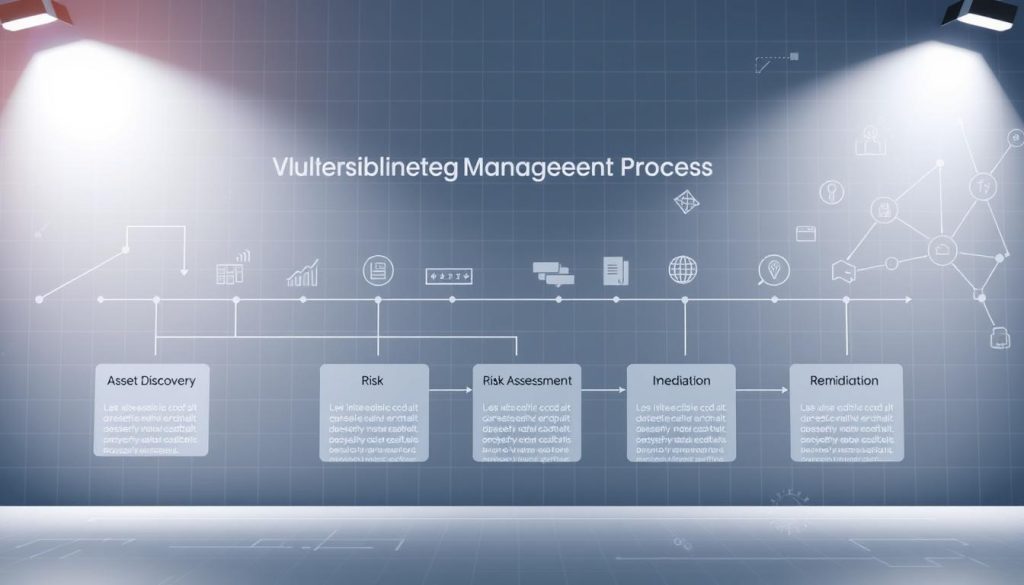
This foundational strategy involves identifying, evaluating, treating, and reporting on technological weaknesses. It is a continuous cycle, not a one-time event. As your network evolves, so must your defenses.
We designed this guide as a complete resource for business leaders and IT professionals. Our goal is to empower you with the knowledge to build a robust security posture. A strong program helps prioritize threats and minimize your attack surface effectively.
Understanding the core principles of a vulnerability management process is the first step toward lasting protection. Let’s begin building your organization’s resilience.
Key Takeaways
- A proactive, systematic approach is essential for protecting digital assets from evolving threats.
- This foundational strategy is a continuous cycle of identification, evaluation, treatment, and reporting.
- As networks grow and change, security measures must adapt continuously to remain effective.
- This guide serves as a comprehensive resource for building a robust organizational security posture.
- Prioritizing potential threats is a critical outcome of a well-implemented program.
- Understanding core principles is the first step toward achieving lasting cyber resilience.
Introduction to the Vulnerability Management Process
As organizations scale their technological infrastructure, they inevitably introduce security exposures that demand continuous oversight. We define vulnerability management as a systematic, cyclical approach to discovering, assessing, and addressing technological weaknesses across your entire digital ecosystem.
These security gaps represent flaws in systems, software, or configurations that attackers can exploit. Every new mobile device, cloud service, or application expands your organization’s attack surface. Third-party integrations and new personnel connections create additional exposure points.
This discipline is not a one-time project but an ongoing security practice. It adapts to evolving threats and changing infrastructure. Unaddressed weaknesses create pathways for data breaches and system compromises.
Effective implementation requires specialized tools, experienced teams, and strategic processes working together. A robust program directly impacts business continuity, regulatory compliance, and stakeholder trust. It transforms reactive security into proactive protection.
We position this approach as fundamental to organizational resilience. It provides the framework for prioritizing risks and minimizing exposure. The goal is systematic protection rather than sporadic fixes.
Understanding Key Components of a Vulnerability Management Program
Modern security programs depend on two critical pillars: knowing your assets and assessing their weaknesses. We outline the essential elements that form the foundation of comprehensive digital protection.
Asset Discovery & Inventory Management
You cannot protect what you do not know exists. Asset discovery provides complete visibility into all devices, software, and systems across your digital environment.
IT asset management (ITAM) systems maintain accurate, real-time records of organizational resources. These tools track location, configuration, and usage patterns throughout the enterprise.
A clear inventory enables organizations to pinpoint where security gaps may exist. This applies to on-premises equipment, cloud resources, and remote work setups alike.
| Asset Type | Discovery Method | Inventory Importance |
|---|---|---|
| Network Devices | Automated Scanning | Critical for access control |
| Software Applications | License Management | Essential for patch tracking |
| Cloud Resources | API Integration | Vital for configuration oversight |
| Mobile Devices | Mobile Device Management | Crucial for remote security |
Vulnerability Scanning & Assessment Tools
These tools conduct systematic tests against systems and networks. They probe for common weaknesses, misconfigurations, and known security issues.
Scanners identify various system types including servers, workstations, and network equipment. Assessment tools correlate system information with databases of public exposures.
Combining asset inventory with scanning creates a powerful foundation for understanding organizational security posture. This approach identifies potential problems before exploitation occurs.
Risk-Based Vulnerability Management Explained
A fundamental shift is occurring in how organizations prioritize their security efforts. We champion a modern, strategic method known as risk-based vulnerability management (RBVM). This approach moves beyond simple counts to focus on the specific dangers each weakness presents.
RBVM evaluates exposures within a broader context. It considers factors like asset importance and active threat intelligence.
Traditional Methods vs. Risk-Based Approaches
Older strategies often treat all security gaps as equal. The goal was to fix as many as possible, which can waste resources on minor issues. Meanwhile, critical flaws that attackers are actively exploiting might be overlooked.
The risk-based approach is fundamentally different. It uses contextual data to identify which problems pose the greatest threat. This ensures teams focus on protecting critical operations and sensitive data first.
This strategic alignment transforms security from a numbers game into a quality-focused discipline. It allows organizations to direct their limited time and budget where it matters most for the business.
The Vulnerability Management Lifecycle
A structured, repeatable framework is essential for turning security concepts into consistent action. We champion a five-step lifecycle that guides organizations from discovery to resolution and improvement.
Assess
The initial step involves discovering security gaps. This is achieved through systematic network scans and detailed assessments. These tools identify misconfigurations and coding flaws across all systems.
Prioritize
Not every finding requires immediate attention. Teams must assign risk scores based on severity and potential business impact. This ensures resources focus on the most critical threats first.
Action
This phase is where remediation occurs. Engineering teams apply patches and configuration changes to repair the identified weaknesses. Each fix is tested to confirm effectiveness.
Reassess
Security is not a one-time event. Continuous monitoring verifies that patches remain reliable. It also detects any new irregularities or changes related to the original issue.
Improve
The final step is a “lessons learned” exercise. Analyzing what worked and what didn’t enables long-term program enhancements. This cyclical nature ensures your security posture adapts and strengthens over time.
Performing a Comprehensive Vulnerability Assessment
Effective security begins with a deep understanding of your digital environment’s weaknesses. A comprehensive vulnerability assessment provides this crucial visibility. It is a systematic examination to uncover security gaps before they can be exploited.

This critical assessment typically involves a scanner that executes a four-stage sequence. It first discovers all network-accessible systems. Then, it identifies open ports and active services.
The tool gathers detailed system information, if possible. Finally, it correlates this data with databases of known security issues. This method builds a complete profile of potential risks.
Evaluating Risks with CVSS and Contextual Data
After identifying potential problems, the next step is evaluation. Platforms often use the Common Vulnerability Scoring System (CVSS). This provides a standardized severity score for each finding.
However, a CVSS score is just a starting point. The true risks depend heavily on context. We must ask critical questions.
Does the affected system handle sensitive information? Is it critical for business operations? Is it accessible from the internet? This data transforms a generic score into an actionable business priority.
Validating Vulnerabilities Through Testing
Scanners are powerful, but not perfect. They can occasionally report false positives. Vulnerability validation is essential for confirming genuine threats.
This testing often uses penetration testing techniques. It simulates real attack scenarios to see if a flaw is actually exploitable. This step ensures teams focus their efforts on real weaknesses, maximizing efficiency and protection.
Implementing the Vulnerability Management Process for Effective Remediation
Organizations face critical decisions once security gaps are identified and validated. We guide teams through three distinct treatment approaches for addressing these weaknesses.
Each method serves different scenarios based on risk levels and available resources. The choice between them directly impacts security effectiveness.
Remediation represents the ideal approach where teams fully fix or patch issues. This permanently eliminates security weaknesses from the environment.
When immediate fixes aren’t available, mitigation provides temporary protection. This strategy lessens exploitation likelihood while awaiting proper patches.
Risk acceptance becomes appropriate for low-impact findings. Organizations deliberately take no action when remediation costs exceed potential damage.
| Treatment Option | Best Use Case | Resource Impact |
|---|---|---|
| Complete Remediation | Critical systems with available patches | High immediate effort, long-term security |
| Mitigation | Waiting for vendor updates | Medium effort, temporary protection |
| Risk Acceptance | Low-risk systems with high fix costs | Minimal effort, documented decision |
Effective implementation requires close collaboration between security and IT teams. Security professionals identify and prioritize issues while technical teams execute fixes.
Following any remediation activities, organizations should run verification scans. This confirms that vulnerabilities have been fully resolved.
The entire approach balances speed with thoroughness. Critical weaknesses receive immediate attention while managing resources across the entire portfolio.
Automation in Vulnerability Management & Modern Tools
The complexity of modern digital environments demands smarter security approaches. We champion automation as the solution for scaling protection across growing infrastructures. These advanced tools transform how organizations handle security gaps.
Integrating SIEM, ITAM, and Patch Management Systems
Modern security platforms integrate multiple specialized systems for comprehensive coverage. Security Incident and Event Management (SIEM) software provides real-time visibility across your entire digital estate.
IT Asset Management (ITAM) integration ensures automatic discovery and tracking of all devices. This creates accurate inventories that evolve with your environment.
Automated patch management coordinates updates across large device fleets. What once took weeks of coordination now completes in days. This integration saves significant time and resources.
Benefits of Automated Scanning and Reporting
Automated scanning continuously monitors for security weaknesses without manual intervention. These tools use scanners and endpoint agents to identify potential problems.
Security teams shift from tactical work to strategic analysis. They focus on interpreting data rather than manual testing.
Automated reporting generates customizable dashboards that track progress over time. This provides clear visibility into security trends for decision-makers.
The approach saves thousands of labor hours annually while improving protection. It allows organizations to manage complex systems effectively as environments change.
Prioritization Techniques for Managing Vulnerabilities
The art of prioritization transforms overwhelming security data into actionable intelligence. We recognize that not all security weaknesses require equal treatment. Effective sorting distinguishes critical threats from minor concerns.
Risk scoring matrices help organizations map severity levels systematically. These tools consider both newly discovered and backlogged issues. This comprehensive approach addresses accumulated security gaps.
Our methodology incorporates multiple contextual factors. Asset criticality, exploitability, and potential business impact guide decision-making. Threat intelligence identifies actively exploited weaknesses in the wild.
| Prioritization Factor | Data Source | Impact on Risk Score |
|---|---|---|
| Asset Criticality | Business Impact Assessment | High – Directly affects resource allocation |
| Exploit Availability | Threat Intelligence Feeds | Medium – Indicates immediate risks |
| Business Impact | Revenue & Operations Analysis | Critical – Determines overall security posture |
| Remediation Complexity | Technical Assessment | Medium – Affects resource planning |
Accurate asset inventories form the foundation for intelligent sorting. We assign business impact scores based on organizational roles. This ensures protection for revenue-generating systems and sensitive data.
Strategic prioritization optimizes limited security resources. It directs attention to the most pressing threats first. This approach balances comprehensive coverage with practical constraints.
The Impact of Patch Management on Overall Security
Patch management serves as the operational backbone of modern cybersecurity strategies. This systematic approach applies vendor-released updates that fix known weaknesses before attackers can exploit them. It transforms identified risks into resolved security gaps.
Specialized software automates the entire update lifecycle. These tools scan for available patches and facilitate deployment across organizational infrastructures. Centralized systems enable simultaneous updates across multiple computers, servers, and devices.
Configuration Management and Secure Software Updates
Security Configuration Management (SCM) software complements patch deployment perfectly. It ensures devices maintain secure configurations even during updates. This prevents configuration drift that could introduce new security issues.
We recommend the NIST SP 800-40 Rev. 4 framework for developing structured programs. This authoritative standard aligns with industry best practices and compliance requirements. Effective patch management directly supports regulatory compliance across various frameworks.
The relationship between patching and vulnerability management is fundamental. Timely updates serve as the primary remediation mechanism for eliminating identified vulnerabilities. This systematic approach reduces organizational risk exposure significantly.
Strategies for Continuous Vulnerability Monitoring and Exposure Management
Digital environments operate in a constant state of flux, demanding security approaches that match their dynamic nature. We champion continuous monitoring as the essential strategy for addressing evolving threats and organizational changes. This persistent vigilance replaces periodic assessments that leave dangerous gaps in protection.
Every technological addition—mobile devices, cloud services, or new applications—creates potential entry points for attackers. Similarly, onboarding partners, employees, or clients introduces new exposure risks. Continuous monitoring ensures organizations maintain visibility into their security posture as their digital footprint expands.
Proactive Asset Tracking & Threat Intelligence
Proactive asset tracking maintains real-time inventories of organizational infrastructure. This enables security programs to automatically account for new assets as they deploy across the network. Accurate inventory management forms the foundation for effective exposure control.
Integrating threat intelligence feeds provides crucial context about actively exploited weaknesses. Security teams can prioritize defenses against the most imminent threats attackers are targeting. This intelligence-driven approach hardens cyber defenses significantly.
Point-in-time scanning leaves organizations vulnerable between assessments. Scanning monthly means exposure for 29 days. Continuous monitoring integrates with broader exposure management strategies, working with attack surface management tools for persistent visibility.
This approach reduces risk exposure and ensures optimal return on security investment. It protects organizations from sophisticated attackers who constantly probe for weaknesses. Security teams can detect and address issues before data exfiltration occurs.
Conclusion: Building a Mature Vulnerability Management Program
The journey toward comprehensive digital protection culminates in establishing a mature, systematic approach to security operations. We help organizations transform from reactive incident response to proactive threat prevention, fundamentally strengthening their overall security posture.
Following established frameworks provides essential structure for designing security mechanisms. This systematic approach ensures proper elimination of weaknesses while aligning remediation efforts with business objectives.
Mature programs instill confidence among industry peers and customers, establishing strong reputations for proactive compliance. This structured precision provides clear justification to stakeholders, increasing support for security initiatives.
The continuous lifecycle—assess, prioritize, action, reassess, and improve—builds organizational capability over time. Each step reduces exposure to security threats while hardening defenses against evolving attacks.
We position ourselves as trusted partners who empower businesses with comprehensive solutions. Our approach delivers optimal return on security investment while protecting critical assets from emerging cyber risks.
FAQ
What is the main goal of a vulnerability management process?
The primary objective is to systematically identify, evaluate, treat, and report on security weaknesses within an organization’s systems. This proactive approach aims to reduce risk and strengthen the overall security posture by addressing potential entry points for attackers before they can be exploited.
How does a risk-based approach differ from traditional vulnerability management?
Traditional methods often prioritize technical severity scores, like CVSS, alone. A risk-based approach integrates business context, asset criticality, and threat intelligence to focus remediation efforts on weaknesses that pose the greatest actual business risk, ensuring resources are allocated efficiently.
What are the essential steps in the vulnerability management lifecycle?
The core lifecycle involves a continuous cycle: assess assets to find weaknesses, prioritize them based on risk, take action through remediation or mitigation, reassess to confirm resolution, and continuously improve the program based on findings and evolving threats.
Why is automation critical in modern vulnerability management programs?
Automation is vital for scaling security efforts across large, dynamic environments. It enables continuous scanning, rapid reporting, and integration with other systems like SIEM and patch management tools, which speeds up response times and reduces the window of exposure for the organization.
How do we effectively prioritize which vulnerabilities to fix first?
Effective prioritization combines the technical severity of a flaw with contextual factors. This includes the asset’s value to the business, whether the asset is internet-facing, active threat intelligence indicating exploitation, and the ease of remediation, ensuring the most critical risks are addressed promptly.
What role does patch management play in the overall process?
Patch management is a key remediation action. It involves the timely deployment of software updates to fix known security weaknesses. A robust patch management strategy, integrated with configuration management, is fundamental to closing security gaps and maintaining compliance.