Did you know that cybersecurity incidents cost businesses an average of $4.35 million per breach in 2022? This staggering figure highlights the critical need for robust digital protection in today’s interconnected economy.

Modern organizations face increasingly sophisticated threats that can compromise sensitive data and disrupt operations. We understand these challenges and provide comprehensive security solutions designed to protect your digital assets.
Our approach focuses on identifying potential weaknesses before malicious actors can exploit them. We combine advanced technical capabilities with clear communication, translating complex findings into actionable business insights.
As your trusted cybersecurity partner, we deliver enterprise-level protection tailored to your specific needs. Our methodology ensures that security measures integrate seamlessly with your existing infrastructure while addressing unique operational challenges.
Key Takeaways
- Cybersecurity breaches cost businesses millions annually
- Proactive security measures are essential for business continuity
- Comprehensive vulnerability identification prevents potential exploitation
- Technical expertise combined with clear communication delivers actionable insights
- Enterprise-level protection requires tailored security solutions
- Security measures must integrate with existing infrastructure
- Informed decisions about risk mitigation support strategic planning
Understanding IT Vulnerability Assessment Singapore
Modern enterprises operate in a landscape where cyber threats have become more complex and pervasive than ever before. We help organizations navigate this challenging environment by providing comprehensive security solutions.
Overview of Cybersecurity Threats and Risks
Today’s digital environment presents unprecedented security challenges. Malicious actors employ sophisticated techniques to exploit weaknesses in network infrastructure and applications.
These attacks can compromise sensitive information and disrupt critical operations. The financial impact of successful breaches continues to escalate significantly.
We identify potential weaknesses across multiple layers of technology infrastructure. This includes outdated software, misconfigured servers, and weak authentication protocols.
Benefits for Businesses in the U.S. Market
American companies gain substantial advantages from proactive cybersecurity measures. Early identification of security gaps prevents exploitation by malicious actors.
Our approach provides clear visibility into organizational risk profiles. Leadership teams can then prioritize investments based on actual threat exposure.
The benefits extend beyond technical protection to include stakeholder confidence and competitive differentiation. Robust security practices demonstrate due diligence to customers and partners.
What is Vulnerability Assessment & Penetration Testing (VAPT)?
In the realm of modern cybersecurity, a two-pronged strategy is essential for comprehensive protection. We define Vulnerability Assessment and Penetration Testing (VAPT) as this combined approach. This service offers a complete snapshot of your security health.
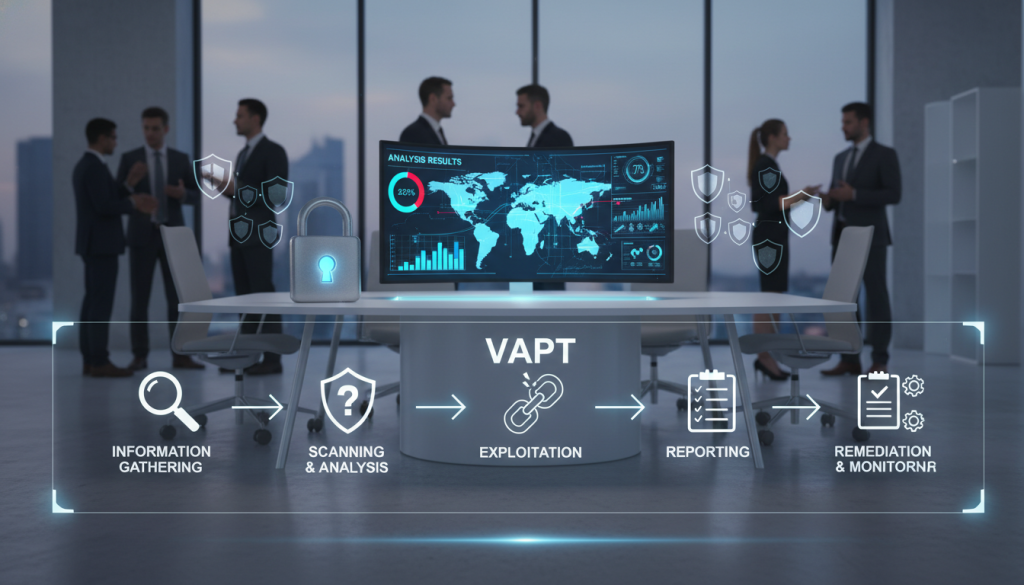
This methodology systematically uncovers and addresses exposures across your entire digital infrastructure. It covers on-premise, cloud, and hybrid systems.
Defining Vulnerability Assessment and its Importance
A vulnerability assessment acts as a thorough health check for your technology. We use advanced tools and expert analysis to scan networks, servers, and applications.
The goal is to find, classify, and prioritize security flaws. This process provides a clear, prioritized list for your remediation team.
Penetration Testing: A Deeper Look into Exploiting Weaknesses
Penetration testing takes the next critical step. Our ethical hackers actively exploit the weaknesses found during the assessment.
This controlled simulation demonstrates how far an attacker could penetrate your defenses. It proves the real-world risk of each identified flaw.
| Feature | Vulnerability Assessment | Penetration Testing |
|---|---|---|
| Primary Focus | Breadth of coverage | Depth of exploitation |
| Main Output | Prioritized list of flaws | Proof of actual breach impact |
| Analogy | Identifying all unlocked doors | Proving an intruder can get inside |
Together, these services deliver a powerful one-two punch for your cybersecurity. They identify problems and prove their business impact.
Types of Vulnerability Scans for Businesses
Modern cybersecurity strategies employ multiple scanning methodologies to address varied attack surfaces. We provide comprehensive scanning services tailored to protect specific components of your technology environment.
Different infrastructure layers require specialized approaches for effective protection. Our scanning solutions target specific areas where security weaknesses commonly occur.
Network-Based and Host-Based Scans
Network-based scanning examines your entire infrastructure for security gaps. This service identifies open ports and insecure configurations across wired and wireless connections.
Host-based scanning focuses on individual systems within your network. This approach uncovers operating system flaws that broader network scans might miss.
Together, these methods provide complete coverage from perimeter to endpoint. They ensure both network-wide and system-specific protection.
Application and Wireless Scans
Application scanning targets your web and mobile software for critical flaws. This testing identifies issues like SQL injection and authentication weaknesses.
Wireless scanning specifically examines your Wi-Fi infrastructure. This service detects unauthorized access points and weak encryption standards.
Both scanning types address common attack vectors in modern business environments. They protect the applications and wireless networks that drive daily operations.
Methodologies and Tools in Vulnerability Assessment
Our security testing framework combines proven methodologies with industry-leading tools for comprehensive coverage. This systematic approach ensures consistent results across all penetration testing engagements.
Reconnaissance, Analysis, Exploitation, and Post-Exploitation
We follow a structured four-phase methodology that begins with reconnaissance. This initial stage involves passive techniques to gather publicly available information without alerting defensive systems.
The analysis phase identifies security weaknesses and determines their severity using industry-standard scoring systems. Our team then moves to exploitation, attempting to gain unauthorized access to demonstrate real-world risks.
Post-exploitation involves thorough documentation of all findings. We provide detailed evidence and actionable recommendations for effective risk mitigation.
Utilizing Leading Tools like Burp Suite and Nmap
Our toolkit includes best-of-breed commercial software such as Burp Suite for deep web application analysis. Nmap provides comprehensive network discovery and port mapping capabilities.
We complement these tools with proprietary scanning solutions developed by our research team. This combination identifies unique or emerging threats that standard tools might overlook.
Manual testing techniques performed by qualified professionals supplement automated systems. This ensures identification of business logic flaws and complex code interactions that require human expertise.
The integration of advanced tools, proven methodologies, and expert analysis delivers comprehensive results. Our vulnerability assessment methodology provides the context necessary for effective remediation planning.
Achieving Compliance and Audit-Readiness
Organizations today face increasing pressure to demonstrate compliance with evolving data protection standards and security frameworks. Our VAPT services provide the documented evidence needed to meet these regulatory demands effectively.
Meeting Regulations such as PDPA and ISO 27001
Regular security testing is essential for maintaining alignment with critical regulations. We help organizations address requirements under frameworks including PDPA and ISO 27001.
Our approach identifies potential gaps before they become compliance issues. This proactive strategy prevents regulatory penalties and mandatory breach notifications.
Financial sector clients benefit from our alignment with Technology Risk Management guidelines. These mandates require regular security testing as part of operational resilience.
Building Accountability and Maintaining Audit Trails
We deliver comprehensive reports that demonstrate due diligence to auditors and regulators. These documents provide clear evidence of your strong cybersecurity posture.
Our detailed findings include complete audit trails documenting testing activities and remediation recommendations. This creates the paper trail expected during compliance reviews.
Building stakeholder trust requires demonstrating serious commitment to security practices. Our services show proactive risk management rather than reactive incident response.
True compliance involves implementing security measures that genuinely protect sensitive information. We focus on reducing risk while meeting regulatory requirements.
Enhancing Cybersecurity Resilience Through Proactive Risk Management
Building lasting digital protection requires more than just defensive tools. We help organizations develop cybersecurity resilience through disciplined identification of potential entry points. This approach transforms security from reactive incident response to strategic risk management.

Our methodology provides comprehensive visibility across your entire technology landscape. Regular scanning uncovers technical flaws before malicious actors can exploit them.
Identifying and Prioritizing Vulnerabilities
We systematically catalog security weaknesses using advanced scanning techniques. This process covers software configurations, network architecture, and access controls.
Not all vulnerabilities present equal danger to your operations. Our risk-based scoring evaluates both technical severity and business impact.
“True security resilience comes from understanding which weaknesses matter most to your specific organization.”
This prioritization ensures your team addresses critical exposures first. Resources focus on flaws that could cause significant operational disruption.
| Factor | Technical Consideration | Business Impact |
|---|---|---|
| Exploitability | Ease of attack execution | Likelihood of successful breach |
| Asset Criticality | System importance to operations | Potential disruption scale |
| Damage Potential | Technical compromise extent | Financial and reputational harm |
Continuous reassessment maintains protection as new threats emerge. This ongoing process builds sustainable security resilience against evolving attacks.
Integrating VAPT into Your Cybersecurity Strategy
Strategic planning transforms security testing from a compliance checkbox into a core business function. We help organizations embed these services within their operational framework for sustained protection.
Our approach ensures penetration testing becomes a continuous process rather than isolated events. This integration maintains visibility across evolving technology landscapes.
Recommended Frequency and Scheduling for Testing
Regular assessments provide the clearest view of your security posture. Most organizations benefit from quarterly penetration testing to match system change cycles.
High-risk sectors like finance require monthly or continuous scanning services. These businesses handle sensitive data demanding elevated protection levels.
Our typical engagement completes scanning within 2-5 business days. Analysis and reporting add 1-3 additional days for comprehensive results.
| Business Type | Recommended Frequency | Primary Benefit |
|---|---|---|
| Standard Organization | Quarterly | Balanced coverage and resource allocation |
| High-Risk Industry | Monthly or continuous | Enhanced protection for sensitive environments |
| After Major Changes | Immediate assessment | Rapid identification of new exposures |
Strategies for Seamless Integration with Existing Systems
We coordinate testing schedules during off-peak hours to maintain business operations. Tool aggressiveness adjusts to prevent network disruption.
Collaboration with your IT team ensures alignment with change management processes. Assessments follow significant infrastructure updates or application deployments.
Our service delivery model emphasizes partnership over rigid protocols. This approach balances thorough testing with operational continuity.
Conclusion
The journey toward comprehensive cyber protection begins with understanding your organization’s unique risk profile. Our security testing services provide this essential foundation, transforming complex technical findings into actionable business intelligence.
Regular penetration testing and systematic vulnerability identification form the core of sustainable digital defense. These services deliver more than just compliance—they build genuine resilience against evolving threats.
We partner with businesses to integrate security measures that protect critical assets while supporting operational continuity. This collaborative approach ensures your team receives clear, prioritized guidance for immediate action.
Our commitment extends beyond individual assessments to ongoing protection and strategic risk management. Trust our expertise to safeguard your operations and maintain stakeholder confidence in an increasingly connected world.
FAQ
What is the difference between a vulnerability assessment and a penetration test?
A vulnerability assessment is a systematic process of scanning your systems, networks, and applications to identify and classify security weaknesses. Penetration testing, or ethical hacking, takes the next step by actively exploiting those discovered vulnerabilities to understand the potential impact on your business. Together, they form a comprehensive VAPT service that provides a complete picture of your security posture.
How often should our organization conduct vulnerability scans and penetration tests?
We recommend conducting vulnerability scans on a quarterly basis, or after any significant change to your network infrastructure or software. A full penetration test should be performed at least annually. For businesses in highly regulated industries or with rapidly evolving digital environments, a more frequent schedule may be necessary to maintain robust cybersecurity resilience.
What compliance standards can a VAPT service help us meet?
Our VAPT services are designed to help your organization achieve and maintain compliance with major standards like the Personal Data Protection Act (PDPA), ISO 27001, and other industry-specific regulations. The detailed reports we provide serve as critical evidence for audits, demonstrating your proactive approach to risk management and data protection.
What happens after the testing is complete?
Following the assessment, we deliver a comprehensive report that details all discovered weaknesses, prioritizes risks based on severity, and provides actionable remediation steps. Our team is available to consult on fixing issues and can perform re-testing to verify that vulnerabilities have been successfully patched, ensuring your systems are secure.
Are these security tests disruptive to our daily business operations?
We employ a careful and collaborative approach to minimize any disruption. Testing is typically scheduled during off-peak hours or in a staged manner. Our goal is to strengthen your security without interrupting your critical business processes, ensuring a seamless integration into your cybersecurity strategy.