A new cyber threat emerges every 39 seconds. This relentless pace creates immense pressure on modern security teams. Without a clear plan, organizations struggle to keep their digital doors locked.
We see many companies facing this challenge. The absence of well-defined ownership leads to confusion and security gaps. Attackers can exploit these weaknesses, putting critical business assets at risk.
Effective protection requires a comprehensive framework. This structure must span from strategic leadership to hands-on technical work. Each function needs distinct expertise and clear ownership to succeed.
This guide serves as a vital resource for business leaders and IT professionals. We provide the knowledge needed to build resilient security programs. Our goal is to help align your defensive initiatives with broader business objectives.
Key Takeaways
- Clearly defined ownership is critical for effective security programs.
- Confusion in accountability creates exploitable security gaps.
- A comprehensive framework spans strategic and operational functions.
- Distinct expertise is required for different aspects of protection.
- This guide helps optimize your organizational structure.
- Alignment between security and business goals is essential.
- Emerging environments like cloud require specific considerations.
Introduction to Vulnerability Management in Today's Cyber Landscape
The accelerating pace of digital transformation has created a security gap that organizations struggle to close. Recent data reveals that 68% of business executives report rising cyber threats, making proactive security measures essential for survival.
Vulnerability management represents a continuous program that identifies security weaknesses and addresses them systematically. This approach ensures timely remediation across all IT infrastructure components.
We observe a critical disconnect at the leadership level. While 82% of board members express cybersecurity concerns, only 38% fully comprehend the issues. This gap highlights the need for clear communication and defined accountability structures.
| Component | Definition | Impact |
|---|---|---|
| Vulnerabilities | Security weaknesses in systems | Create exploitation opportunities |
| Threats | Potential danger actors | Seek to exploit weaknesses |
| Risk | Combination of threat and vulnerability | Requires immediate attention |
The cybersecurity talent shortage intensifies these challenges. Organizations must maximize their limited security resources through strategic specialization. Effective role allocation becomes critical for maintaining robust defenses.
This systematic approach forms the foundation of healthy cybersecurity strategy. It enables teams to reliably identify and resolve issues before they escalate into serious incidents.
Vulnerability Management Roles and Responsibilities
Modern security demands specialized focus through carefully distributed functions. We define this framework as the systematic assignment of specific security duties to designated personnel. This ensures every aspect of the protection lifecycle maintains clear ownership.
Ambiguity in task allocation creates dangerous coverage gaps. Attackers exploit these weaknesses when responses delay or critical issues go unnoticed. Well-defined assignments prevent this confusion and maintain robust defensive postures.
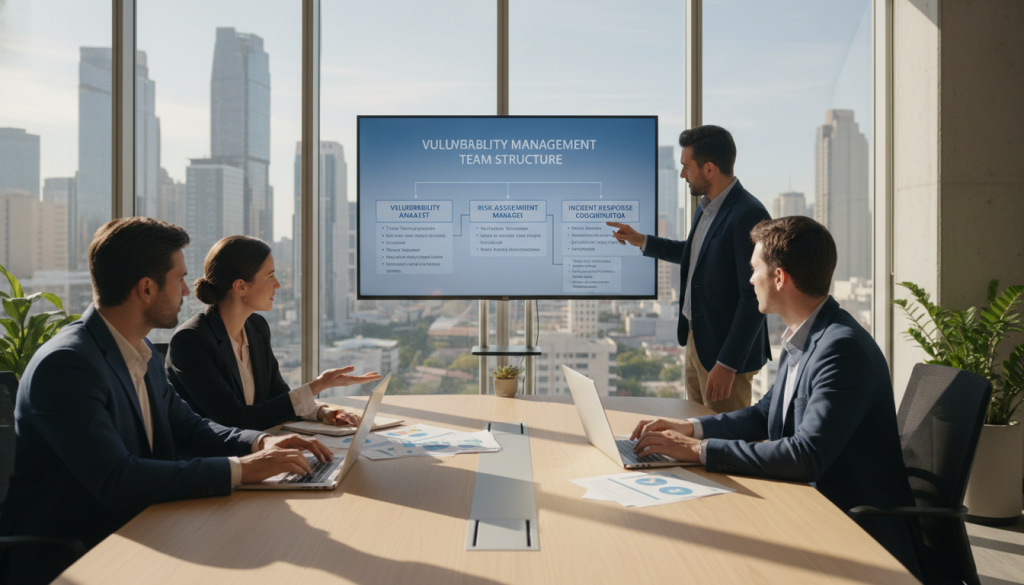
Four core positions form the foundation of any effective program. The Security Officer oversees the entire protection process from start to finish. Vulnerability Engineers handle scanning schedules and tool maintenance.
Asset Owners maintain responsibility for systems undergoing assessment. IT System Engineers implement corrective measures identified through scanning. This specialization allows each professional to develop deep expertise.
Strategic guidance flows seamlessly from leadership to technical teams. Executive insights translate into actionable security priorities throughout the organization. This alignment ensures resource allocation matches business risk tolerance.
Operational efficiency improves dramatically with clear duty boundaries. Specialists can focus on threat intelligence, patch verification, or compliance checking. Decision-making accelerates when everyone understands their specific contributions.
Communication channels become naturally organized through this structure. Reporting lines remain unambiguous during incident escalation procedures. The entire organization benefits from this coordinated approach to digital protection.
The Evolving Threat Landscape and Its Impact on Security
The convergence of emerging technologies and global connectivity has dramatically expanded the corporate attack surface. We see new security vulnerabilities appearing constantly in cloud platforms, remote work tools, and IoT devices. This requires a proactive, not reactive, stance.
A threat is any entity capable of executing a cyberattack. These threats range from individual hackers to organized crime rings.但他们需要找到可利用的弱点才能成功。
Understanding the adversary is the first step toward building an effective defense.
When a weakness exists and a threat actively targets it, genuine risk emerges. This can lead to severe data breaches and financial harm. Modern organizations must defend against a diverse set of actors.
| Threat Actor | Primary Motivation | Common Targets |
|---|---|---|
| Cybercriminals | Financial Gain | Customer Data, Financial Systems |
| Hacktivists | Ideological Goals | Corporate Websites, Public Data |
| Nation-States | Espionage, Disruption | Critical Infrastructure, IP |
This knowledge allows organizations to prioritize fixing the most critical security vulnerabilities first. By analyzing which flaws are actively exploited, teams can allocate resources wisely. This strategic focus reduces overall risk effectively.
Strategic Guidance for Executive and Board-Level Cybersecurity
Executive leadership faces a critical translation challenge between technical security findings and strategic business decisions. We observe boards acknowledging security importance while lacking clear implementation pathways. This gap creates operational disconnects that weaken overall protection.
Aligning Security Strategy with Business Goals
The Chief Information Security Officer serves as the essential bridge between technical teams and leadership. This professional translates complex findings into business-impact language. Financial consequences and operational risks become clear to non-technical decision-makers.

Effective alignment ensures resource allocation matches organizational priorities. Protection efforts focus on assets supporting revenue generation and service delivery. This strategic approach balances security requirements with growth objectives.
Communicating Risk and Gaining Leadership Support
Regular reporting mechanisms like monthly threat briefings narrow knowledge gaps. These communications must provide actionable insights rather than technical overload. Clear data enables informed decisions about budget approvals and risk acceptance.
We emphasize demonstrating security’s return on investment through quantified risk reduction. Proactive measures should enable innovation rather than constrain it. This perspective fosters security awareness as a business imperative throughout the organization.
Leadership support grows when understanding how protection affects customer trust and competitive positioning. The entire organization benefits from this elevated security culture.
Operational Efficiency in SecOps and IT Teams
Operational coordination between security and IT teams creates the foundation for rapid threat response. Without structured assignments, critical security gaps often go unaddressed. Multiple groups may assume others handle specific remediation tasks.
Division of Responsibilities for Faster Remediation
Well-documented procedures transform vulnerability remediation from reactive to systematic. These standards enforce deadlines and accountability measures throughout the security process. Clear documentation establishes predictable protection operations.
Specialization emerges when analysts focus on specific domains like patch testing or threat intelligence. This focused approach develops deep expertise within the security team. Engineers become highly proficient in their designated functions.
SecOps professionals execute daily security operations and monitor threats continuously. IT specialists implement patches and maintain system stability during remediation. This division creates efficient workflow boundaries.
Regular synchronization meetings and shared dashboards maintain operational coordination. Escalation procedures ensure critical vulnerabilities receive immediate attention. This structured approach significantly reduces exposure windows between discovery and resolution.
The entire protection process benefits from this organized framework. Teams operate with greater speed and confidence in their specific responsibilities. Operational efficiency becomes measurable through reduced risk exposure.
Core Roles in a Vulnerability Management Team
Building an effective security framework requires clearly defined positions with specialized expertise. We observe that organizations with structured teams achieve stronger protection outcomes. Each function contributes unique skills to the overall defense strategy.
Overview of Key Positions
The Chief Information Security Officer leads the entire security program. This executive ensures alignment between protection efforts and business objectives. Their strategic vision guides the entire vulnerability management team.
Security Operations professionals handle daily monitoring and threat response. They maintain continuous vigilance across organizational systems. Their work forms the operational backbone of the protection framework.
Specialized analysts focus on identifying and classifying security weaknesses. These experts use advanced tools to scan networks and applications. Their detailed assessments inform critical remediation decisions.
Real-World Salary Insights and Role Expectations
Compensation reflects the critical nature of these positions. CISOs in large enterprises typically earn $250,000 to $350,000 annually. Mid-sized organizations offer $180,000 to $250,000 for this leadership role.
Senior SecOps engineers command $100,000 to $150,000 in today’s market. Management positions in this area reach $160,000 or higher. Specialized analysts earn between $80,000 and $110,000 based on experience.
Understanding these compensation ranges helps organizations attract qualified talent. Proper investment in skilled professionals strengthens overall security posture. Strategic staffing decisions directly impact protection effectiveness.
Patch Management and Remediation Strategies: Bridging IT and DevOps
Once security weaknesses are identified through comprehensive scanning, the real challenge begins with systematic remediation. This critical phase transforms detection into protection through coordinated efforts across technical teams.
We observe that effective patch deployment requires balancing security urgency with operational stability. IT professionals must test updates thoroughly before production implementation. DevOps teams integrate automated solutions into continuous delivery pipelines.
The remediation process follows risk-based prioritization to address the most critical issues first. Teams apply vendor-supplied updates or reconfigure systems to mitigate exposure. Documentation throughout this process ensures accountability and supports future audits.
Modern approaches incorporate DevOps principles like infrastructure as code and immutable architecture. These methods replace systems rather than patching them in place. This shift requires IT staff to develop new skills and adapt processes.
| Traditional Approach | Modern Strategy | Key Benefits |
|---|---|---|
| Manual patch deployment | Automated CI/CD integration | Faster response times |
| Individual system updates | Immutable infrastructure | Reduced configuration drift |
| Reactive maintenance windows | Proactive vulnerability addressing | Continuous protection |
Clear service level agreements based on severity levels streamline collaboration between teams. Establishing rollback procedures and regular maintenance windows ensures smooth operations. This structured approach minimizes disruption while maximizing security effectiveness.
Risk Management, Compliance, and Governance in Vulnerability Management
Risk management transforms raw vulnerability data into strategic business intelligence for informed decision-making. This critical function bridges technical findings with executive leadership needs.

Integrating Risk Assessments with Security Policies
We establish clear frameworks that prioritize security issues based on business impact. Financial consequences, operational disruptions, and reputational damage receive weighted evaluation. This approach ensures resource allocation matches organizational risk tolerance.
Technical teams follow defined guidelines when addressing security findings. They consider exploitation likelihood, potential damage, and remediation costs. This systematic process prevents treating all issues as equally urgent.
Compliance integration maps security controls to regulations like GDPR and HIPAA. Independent assessments identify gaps before audits or incidents occur. Governance structures establish accountability and documentation requirements.
| Risk Response | Business Rationale | Compliance Alignment |
|---|---|---|
| Remediate | High impact on critical operations | Mandatory regulatory requirements |
| Mitigate | Moderate impact with cost constraints | Industry best practices |
| Accept | Low probability with high remediation cost | Documented business justification |
Comprehensive records support audit trails and insurance claims. This documentation demonstrates due diligence during regulatory reviews. Effective governance creates continuous improvement through historical data analysis.
Organizations benefit from this integrated approach to security decision-making. It aligns technical efforts with business objectives and compliance needs.
Common Pitfalls and Overlaps in Organizing Security Responsibilities
Even with meticulous planning, security teams frequently encounter organizational blind spots that undermine their protection efforts. These gaps often emerge from structural weaknesses rather than technical failures.
We observe overlapping accountability as a primary challenge. Different groups within organization often pursue separate solutions to identical problems. This duplication wastes resources and creates conflicting remediation approaches.
Overlapping Accountability and Inconsistent Role Updates
Without clear oversight, enterprise security roles become confused. Critical exposures may fall through organizational cracks when multiple teams assume others handle them. This confusion creates dangerous coverage gaps.
The evolving threat landscape demands regular updates to security responsibilities. New technologies and compliance requirements necessitate process adjustments. Outdated frameworks leave modern attack vectors unaddressed.
Communication breakdowns between departments create dangerous delays. When SecOps discovers critical issues but DevOps remains unaware, remediation windows extend unnecessarily. This lack of coordination increases exploitation risk.
Executive visibility often suffers from reporting issues. Technical details may overwhelm non-security leaders, while vague summaries fail to support informed decisions. Both extremes hinder proper resource allocation.
Unclear escalation frameworks cause inconsistent response patterns. Teams may treat minor and major security exposures with equal urgency. This misalignment wastes effort on low-risk issues while under-prioritizing critical threats.
Recognizing these common pitfalls represents the essential first step toward prevention. Proactive design of security structures minimizes confusion and ensures clear ownership throughout the organization.
Best Practices for Vulnerability Scanning, Reporting, and Analysis
Systematic scanning procedures form the foundation of modern security operations. We implement continuous discovery processes rather than periodic assessments. This approach catches weaknesses introduced through software changes or configuration updates.
Comprehensive coverage extends across all infrastructure components. Authenticated scans provide deeper visibility than external assessments alone. This methodology ensures complete asset inventory and accurate risk evaluation.
Effective Vulnerability Scanning Techniques
Integration throughout development lifecycles prevents issues reaching production. Scans in staging environments identify problems before deployment. Continuous monitoring catches newly disclosed security flaws.
Analysis evaluates multiple factors beyond technical scores. We consider exploit availability and business impact. This contextual assessment prioritizes remediation effectively.
Clear Reporting and Escalation Processes
Effective reporting transforms raw data into actionable intelligence. Clear categorization based severity levels guides response teams. Executive summaries communicate risk in business terms.
Escalation protocols define immediate response requirements. Critical scores combined with active exploitation demand urgent attention. This structured process reduces exposure windows significantly.
Verification scans confirm successful remediation actions. Using identical tools and settings ensures accurate comparison. This validation step completes the protection cycle.
Integrating Vulnerability Management into Cloud and CI/CD Environments
Cloud-native environments fundamentally reshape how organizations approach digital protection. We observe unique challenges arising from diverse workload types across modern infrastructure. Virtual machines, containers, and serverless functions each present distinct security considerations.
The dynamic nature of cloud platforms demands continuous monitoring. Configurations change rapidly as workloads scale and applications update. Traditional periodic scanning often misses ephemeral resources that appear briefly.
Cloud security requires thinking in terms of continuous compliance rather than point-in-time assessments.
Integration with CI/CD pipelines enables shift-left security practices. Scanning during development stages catches issues before production deployment. This approach significantly reduces exposure windows for critical flaws.
Effective cloud protection requires multi-layer assessment capabilities. We scan container images, infrastructure templates, and runtime configurations simultaneously. Automated security gates prevent deployments when serious issues are detected.
| Scanning Layer | Traditional Approach | Cloud-Native Method |
|---|---|---|
| Container Images | Post-deployment assessment | Pre-registry scanning |
| Infrastructure Code | Manual configuration review | Automated template analysis |
| Runtime Environment | Scheduled scans | Continuous monitoring |
Specialized tools provide deeper visibility into cloud architectures. These solutions understand microservices and serverless functions better than traditional scanners. API-driven automation seamlessly integrates with DevOps workflows.
Comprehensive asset inventories automatically discover new cloud resources. This ensures complete coverage across evolving environments. The result is robust protection that keeps pace with digital transformation.
Selecting Tools and Technologies for Comprehensive Vulnerability Management
Marketplace diversity in security tools presents both opportunities and challenges for organizations. We observe numerous scanning options available, each with different capabilities and accuracy levels.
Evaluation of Vulnerability Scanners and Automated Tools
Effective tool evaluation requires assessing multiple critical factors. Scalability ensures solutions can handle growing IT environments without performance degradation.
Reliability maintains continuous operation for comprehensive security coverage. Accuracy minimizes false positives while detecting real threats effectively.
Integration capabilities with existing systems streamline workflow efficiency. Quality reporting transforms technical data into actionable information for teams.
Balancing Cost, Quality, and Efficiency
Strategic selection balances financial constraints with protection needs. The most expensive solutions aren’t always optimal for every organization.
Environment complexity and staff expertise influence ideal tool choices. Compliance requirements and available resources guide final decisions.
Leading options include Appknox for mobile application security testing. Nessus/Tenable provides comprehensive infrastructure assessment capabilities.
| Tool Type | Primary Strength | Ideal Use Case |
|---|---|---|
| Network Scanners | Infrastructure assessment | Corporate networks |
| Application Testing | Code analysis | Web applications |
| Cloud Platforms | Native resource protection | Cloud environments |
Multiple complementary tools often provide the most comprehensive coverage. This approach addresses diverse security needs across different system types.
Conclusion
As organizations navigate increasingly sophisticated cyber risks, the human element of security proves equally critical as technological defenses. We emphasize that clear accountability structures form the foundation of effective protection programs. Properly defined duties ensure seamless coordination across all security functions.
This approach represents a continuous discipline rather than periodic activity. Sustained organizational focus transforms security from reactive measures to proactive business strategy. The resulting framework delivers measurable value through risk reduction and compliance assurance.
Investing in well-structured security coordination prevents costly incidents while enabling secure innovation. Organizations gain resilience against evolving threats through this systematic approach. Ultimately, clear security ownership becomes the cornerstone of long-term business success in our digital landscape.
FAQ
What is the primary goal of a vulnerability management program?
The main objective is to systematically identify, classify, remediate, and mitigate security weaknesses across an organization’s IT assets. This proactive process aims to reduce the attack surface and protect critical business data from potential threats.
Who is typically responsible for overseeing the vulnerability management process?
Overall accountability often rests with the Chief Information Security Officer (CISO) or a senior security leader. However, successful execution requires collaboration between SecOps engineers, who handle scanning and analysis, and IT/DevOps teams, who perform the actual remediation and patch management.
How often should vulnerability scans be performed?
Scanning frequency depends on the asset’s criticality and the rate of environmental change. Best practices suggest continuous or daily scans for critical public-facing systems, weekly or monthly for internal assets, and scans integrated into every CI/CD pipeline build for development environments.
What is the difference between vulnerability management and patch management?
Vulnerability management is the broader, strategic process of finding and assessing security flaws. Patch management is a tactical subset focused specifically on applying software updates to fix those flaws. Not all vulnerabilities are resolved with a patch; some require configuration changes or other mitigation strategies.
How can organizations effectively prioritize which vulnerabilities to fix first?
Prioritization should be based on a combination of factors, including the severity score (like CVSS), the context of the affected asset (e.g., its exposure and business value), and the availability of an exploit. Using a risk-based approach ensures resources are allocated to address the most significant threats to the business.
What are common challenges in building an effective vulnerability management team?
Key challenges include securing adequate budget and skilled personnel, avoiding responsibility gaps or overlaps between IT and security teams, managing the volume of scan data, and ensuring timely remediation without disrupting business operations or development cycles.
How does cloud computing change traditional vulnerability management responsibilities?
Cloud environments introduce a shared responsibility model. While the cloud provider secures the infrastructure, the customer is responsible for securing their data, applications, and operating systems. This requires adapting scanning tools and processes for dynamic, API-driven environments and often involves closer collaboration with DevOps.
What should be included in a vulnerability management report for leadership?
Executive reports should focus on business risk, not technical details. They typically include metrics like overall risk posture trends, time to remediate critical flaws, the number of high-severity threats affecting key business systems, and how the program aligns with compliance requirements and business objectives.