Last year, a staggering 768 Common Vulnerabilities and Exposures (CVEs) were actively exploited by attackers. This represents a sharp 20% increase from the previous year. This surge highlights a critical and escalating challenge for every modern business.

Organizations now face a complex digital battlefield. Traditional, fragmented security tools often create more problems than they solve. They leave dangerous gaps in your defenses and overwhelm teams with disconnected alerts.
We offer a better way forward. Our comprehensive approach consolidates your entire security posture into a single, cohesive platform. This provides the centralized visibility and control you need to stay ahead of threats.
Our mission is to empower your business with proactive protection. We act as your dedicated partner, combining proven expertise with innovative technology. Our goal is to simplify your security, accelerate response times, and significantly reduce organizational risk.
Key Takeaways
- A 20% increase in exploited vulnerabilities last year underscores the urgent need for robust security.
- Disconnected security tools create visibility gaps and operational complexity.
- Our solution consolidates security processes into a single, unified platform.
- We provide centralized visibility and automated remediation capabilities.
- Our expertise helps businesses simplify security and reduce risk exposure.
- We partner with organizations to strengthen their overall security posture.
Introduction to Unified Vulnerability Management
As digital ecosystems grow more complex, the limitations of fragmented security tools become increasingly apparent. Organizations struggle with disconnected systems that create dangerous visibility gaps across their infrastructure.
Defining the Concept
We define this approach as a centralized method that consolidates security processes across an organization’s entire digital footprint. Unlike traditional methods that focus on isolated IT assets, this strategy integrates findings from cloud, containers, web applications, and operational technology.
The core capabilities include integration with existing assessment tools, normalization of asset information, and comprehensive visibility across the entire attack surface. This creates what we call a “single pane of glass” for security data.
Why It Matters for Modern Cybersecurity
This methodology addresses critical challenges that traditional approaches miss. Attackers increasingly target overlooked domains where conventional tools lack coverage.
Fragmented systems create noise and confusion, making it difficult to identify genuine threats. Our unified vulnerability management approach ensures no segment of your digital environment is neglected.
This consolidation reduces organizational exposure by providing clear prioritization and coordinated response across all teams. It transforms how businesses manage their security posture in an evolving threat landscape.
The Evolution of Unified Vulnerability Management
Over the past several years, vulnerability management platforms have undergone significant evolutionary changes. This progression reflects the growing complexity of modern digital infrastructure and the need for more sophisticated security approaches.
First Wave of UVM Solutions
The initial phase (2018-2022) focused on foundational challenges. Early platforms aggregated findings from assessment tools like Qualys, Rapid7, and Tenable. They implemented basic deduplication using CVE identifiers and host names.
These first-generation solutions integrated threat intelligence to help prioritize risks. They also created ticketing integrations with platforms like ServiceNow and Jira. This allowed security teams to streamline their workflow effectively.
New Era Innovations in UVM
Starting in 2022, technological megatrends drove a paradigm shift. Cloud adoption required solutions to handle dynamic infrastructure. Platforms needed frequent data pulls and common schemas.
Newer tools expanded beyond CVEs to address broader exposures. They developed data models for misconfigurations and exposed secrets. This provided more comprehensive coverage.
The most critical advancement involved application context. Modern solutions connect to source code management and CI/CD platforms. They link application findings with corresponding infrastructure and ownership details.
Core Capabilities of Unified Vulnerability Management
At the heart of any robust security program are the core capabilities that transform raw data into actionable intelligence. Our platform delivers these essential functions through advanced integration and visualization technologies.
Data Integration and Deduplication
We eliminate the confusion of multiple security consoles. Our system normalizes findings from various scanning tools into a single repository.
This process removes duplicate entries and conflicting information. Teams gain clear visibility into actual risks across the entire infrastructure.
Unified Asset Inventory and Visualization
Our platform creates a comprehensive inventory of all digital assets. This includes servers, endpoints, mobile devices, and cloud workloads.
The visualization dashboard provides immediate insight into asset relationships and risk exposure. Security teams can quickly identify which systems require attention.
| Capability | Traditional Approach | Our Platform |
|---|---|---|
| Data Integration | Multiple disconnected consoles | Single unified repository |
| Asset Visibility | Limited to specific tool coverage | Comprehensive across all assets |
| Risk Prioritization | Based on theoretical scores | Context-aware actual threat assessment |
These capabilities form the foundation of effective security operations. They enable proactive protection rather than reactive responses to emerging threats.
Benefits Over Traditional Vulnerability Management
Many organizations discover their current security tools actually increase operational complexity. Our approach transforms this challenge into strategic advantage.

We consolidate fragmented systems into a cohesive protection framework. This eliminates the confusion of multiple security consoles.
Enhanced Compliance and Reporting
Our platform delivers comprehensive reporting capabilities that streamline audit preparation. You gain clear visibility into remediation status across all assets.
Documentation becomes straightforward with automated tracking of SLA compliance. Risk acceptance decisions are properly recorded for regulatory requirements.
Accelerated Remediation and Prioritization
Security teams can focus on actual threats rather than administrative coordination. Our system provides contextual intelligence for faster decision-making.
Remediation guidance becomes actionable with business context integration. This reduces mean-time-to-remediation significantly.
| Aspect | Traditional Approach | Our Solution |
|---|---|---|
| Compliance Reporting | Manual consolidation from multiple sources | Automated comprehensive reporting |
| Risk Prioritization | Based on theoretical scores alone | Context-aware actual threat assessment |
| Team Coordination | Multiple handoffs between siloed groups | Unified workflow across all security teams |
One security leader noted:
“The consolidation of our security data transformed how we manage risk. We now address threats before they become incidents.”
This integrated approach strengthens your overall security posture while reducing operational overhead.
Unified Vulnerability Management in Cloud Environments
The ephemeral nature of modern cloud assets creates unique security gaps that demand specialized solutions. Traditional approaches struggle to keep pace with cloud infrastructure’s dynamic characteristics.
Addressing Cloud-Specific Challenges
Cloud platforms operate at speeds that conventional security tools cannot match. Containers and serverless functions may appear and disappear within minutes, creating visibility windows that attackers can exploit.
We integrate directly with cloud providers through APIs for real-time scanning capabilities. This approach captures threats between scheduled assessments when traditional methods would miss critical exposures.
Our platform bridges the gap between isolated security tools that create data silos. It provides unified visibility across IT, cloud, and operational technology environments.
| Security Aspect | Traditional Challenge | Our Cloud Solution |
|---|---|---|
| Asset Visibility | Static scans miss ephemeral resources | Real-time API integration |
| Data Consolidation | Siloed information across tools | Unified data schema |
| Threat Detection | Limited to scheduled assessments | Continuous monitoring |
This comprehensive approach ensures your teams can identify risks before deployment. It maintains consistent protection across your entire hybrid infrastructure.
Implementing a Successful Unified Vulnerability Management Strategy
A successful implementation begins with a clear-eyed view of your current security landscape. We guide organizations through a thorough readiness assessment to identify existing tools, scanning methods, and potential gaps. This baseline is critical for a smooth transition.
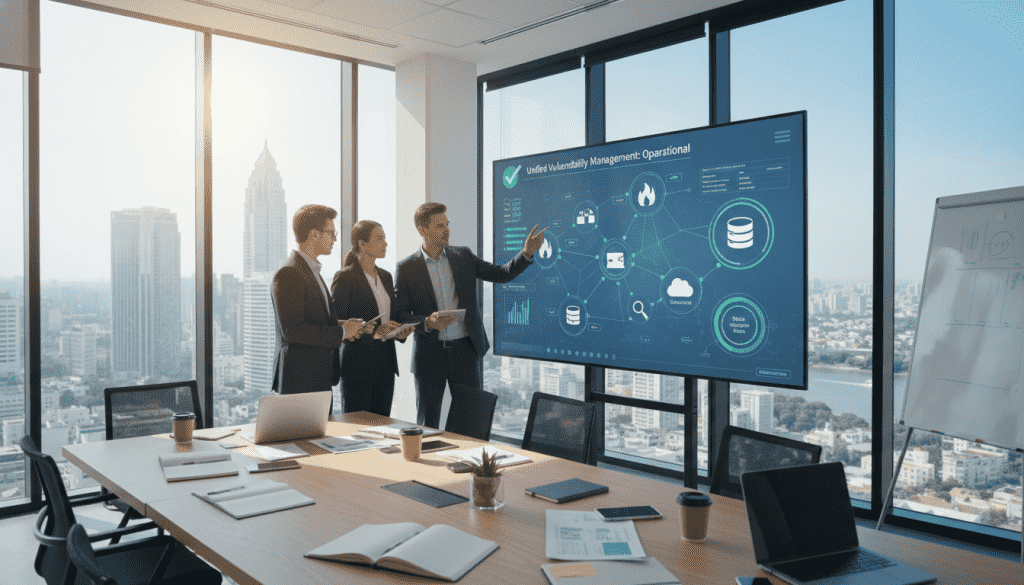
Establishing clear objectives and key performance indicators (KPIs) is the next vital step. Metrics like mean time to patch provide a quantifiable roadmap for progress.
Conducting a Readiness Assessment and Platform Selection
Our assessment process inventories your current scanning and patch routines. We pinpoint overlaps and weaknesses to define what needs enhancement.
Choosing the right platform is paramount. The solution must align with your organization’s size, compliance needs, and existing IT structure. Scalability and real-time analytics are non-negotiable features.
| Implementation Factor | Common Pitfall | Our Recommended Approach |
|---|---|---|
| Platform Selection | Choosing based on features alone | Prioritizing integration and compatibility |
| Team Readiness | Assuming existing skill sufficiency | Comprehensive training before rollout |
| Rollout Strategy | Big-bang deployment across all assets | Phased implementation starting with a limited pool |
Training Teams and Establishing Accountability
We deliver detailed training on scheduling scans, interpreting data, and initiating remediation. This ensures every team member understands their role.
Clear accountability structures prevent confusion. We help distribute specific responsibilities for administration, remediation, and compliance coordination.
“A phased rollout minimized our operational disruption and allowed teams to build confidence with the new system gradually.”
Regular audits measure the solution’s effectiveness, enabling continuous improvement of your security posture.
Measuring Success Through Metrics and Reporting
Quantifiable metrics provide the definitive proof that your security investments are delivering tangible results. Our approach leverages established measurements that security professionals have trusted for years.
This makes it straightforward to demonstrate improvements and return on investment to organizational leadership. You gain clear visibility into whether your security program is accelerating gap closure.
Mean Time to Remediate and Vulnerability Age
Mean time to remediate (MTTR) tracks the average duration from threat discovery to resolution. Successful implementations typically show substantial reductions in this critical timeframe.
Tracking average vulnerability age reveals how long security gaps persist before resolution. This metric clearly shows whether your approach outperforms traditional methods.
We also monitor SLA adherence percentages across all asset categories. Our platform ensures consistent compliance with established remediation timelines.
Vulnerability recurrence rates indicate whether fixes address root causes. Effective solutions show reduced repetition through contextual guidance that targets underlying issues.
These measurements support compliance requirements by demonstrating sustained security posture improvements. Teams gain unified visibility that was impossible with siloed tools.
Conclusion
As security challenges intensify, businesses require more than incremental improvements to their defense strategies. With forecasts predicting over 51,000 CVEs by 2026 and a 20% increase in exploited exposures last year, the need for comprehensive protection has never been more urgent.
Our approach represents a fundamental transformation in how organizations safeguard their digital assets. We provide the unified visibility and context-aware prioritization that traditional tools cannot deliver. This enables your teams to focus on genuine threats rather than administrative overhead.
The benefits extend from accelerated remediation to enhanced compliance reporting, significantly reducing business risk. We partner with you throughout implementation, ensuring measurable improvements in your security posture.
Contact our cybersecurity experts to design a tailored strategy that addresses your specific technology environment and protection objectives.
FAQ
What is the primary difference between traditional tools and a unified approach?
Traditional security tools often operate in isolation, creating data silos. A unified platform integrates findings from various scanners, cloud environments, and threat intelligence into a single view. This eliminates duplicate data and provides comprehensive context for accurate risk prioritization and faster remediation.
How does this solution improve our organization’s security posture?
By unifying all vulnerability data, we provide a complete picture of your attack surface. This allows for smarter risk assessment and prioritization based on actual business impact. Teams can then focus remediation efforts on the most critical exposures, significantly strengthening your overall security posture and compliance status.
Can this platform handle assets in complex cloud environments?
A>Yes. Our solution is designed to seamlessly integrate with major cloud platforms. It provides specialized scanning and assessment capabilities for cloud-native applications and infrastructure. This ensures continuous visibility and protection for your dynamic technology assets, addressing cloud-specific challenges effectively.
What key metrics should we track to measure the success of our program?
We recommend focusing on metrics like Mean Time to Remediate (MTTR) and vulnerability age. Tracking these KPIs demonstrates how quickly your teams can address critical findings. It provides clear evidence of improved operational efficiency and a reduction in potential attack vectors over time.
How does the platform assist with compliance reporting?
Our tools automate the collection and correlation of security data required for various compliance frameworks. This generates accurate, audit-ready reports on demand. It simplifies the process of demonstrating due diligence and adherence to regulatory standards, saving valuable time and resources.