A single overlooked software flaw can expose an entire enterprise to devastating consequences. These foundational security concepts form the bedrock of every effective digital defense strategy. We believe clear understanding empowers stronger protection.
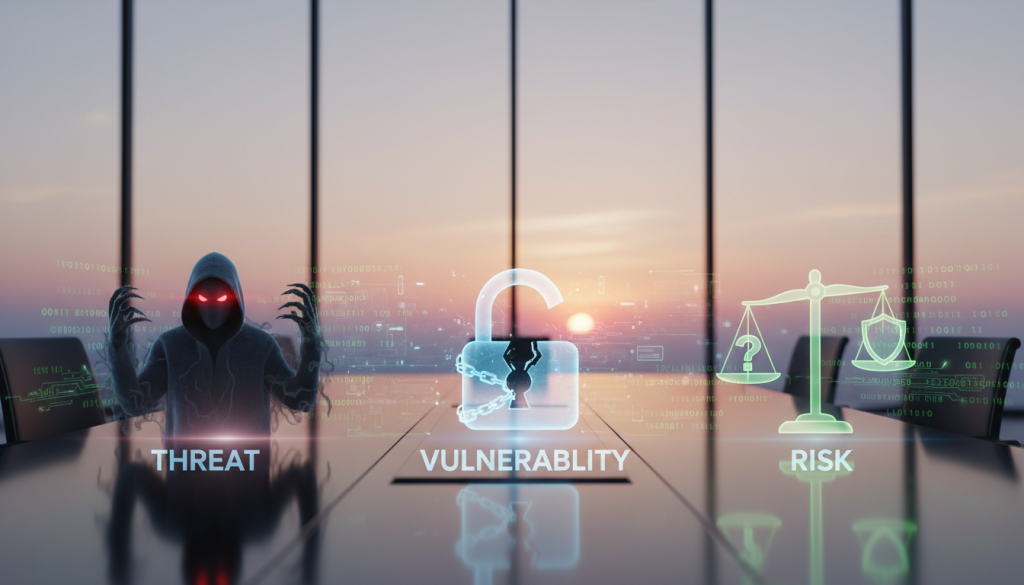
Many organizations use terms like threat, vulnerability, and risk interchangeably. This creates confusion and weakens security planning. Precise definitions are critical for building robust defenses.
We clarify these distinct components to help your team communicate effectively. A weakness in your systems is a vulnerability. A potential event that could attack that weakness is a threat. The combination defines your overall risk.
Understanding this relationship allows for smarter resource allocation. You can prioritize addressing the most critical exposures. This guide provides the clarity needed for informed decision-making.
Key Takeaways
- Threat, vulnerability, and risk are distinct but interconnected security concepts.
- Confusing these terms leads to ineffective security strategies and communication gaps.
- A vulnerability is a weakness that can be exploited in people, processes, or technology.
- A threat is any potential event or actor that could exploit a vulnerability.
- Risk represents the potential for loss or damage when a threat successfully exploits a vulnerability.
- Clear understanding of these distinctions is essential for prioritizing security efforts.
- This foundational knowledge supports the development of a robust cybersecurity posture.
Introduction to Cybersecurity Fundamentals
The escalating sophistication of cyberattacks demands more than just advanced tools; it requires a fundamental shift in organizational mindset. A robust security posture is built upon a clear, shared understanding of what we are protecting and why. This foundational knowledge is critical for every business.
Setting the Stage for a Secure Environment
Protection begins by identifying valuable assets. These are the people, information, intellectual property, and physical infrastructure that a business depends on. A unified view of these assets across technical and leadership teams is essential.
True cybersecurity strength comes from this alignment. Confusion about basic concepts creates communication gaps. These gaps directly weaken an organization‘s defenses.
Understanding the Importance for U.S. Organizations
The financial stakes are higher than ever. The average cost of a data breach reached $4.45 million in 2023. This trend makes proactive security a necessary investment, not an optional cost.
Effective protection requires everyone to speak the same language. When teams understand core cybersecurity principles, they can better safeguard critical systems. This shared understanding fortifies the entire organization against modern dangers.
| Asset Category | Examples | Potential Impact of Loss |
|---|---|---|
| People & Knowledge | Employees, customer lists, proprietary processes | Operational disruption, loss of competitive edge |
| Digital Information | Financial records, intellectual property, customer data | Financial penalties, reputational damage, legal liability |
| Physical Infrastructure | Servers, network hardware, office facilities | Service downtime, physical safety risks |
Securing these systems and assets is a continuous process. It starts with mastering the fundamentals we outline here. This knowledge empowers smarter decisions and stronger defenses.
Clarifying Core Cybersecurity Concepts
Organizations face countless security exposures, but not all weaknesses carry equal danger. We define these distinct components to help teams prioritize effectively.
Defining Vulnerability in Modern Systems
A vulnerability represents any weakness or flaw in your infrastructure. These shortcomings can exist in technology, processes, or human factors.
Technical vulnerabilities include code bugs and hardware errors. Human weaknesses involve susceptibility to social engineering attacks.
What Constitutes a Threat?
Threats are potential events or actors that could exploit vulnerabilities. They target the confidentiality, integrity, and availability of your systems.
Advanced threats possess opportunity, capability, and intent. They actively seek to compromise organizational assets.
Measuring Risk in Cyber Environments
Risk quantifies the probability and magnitude of potential loss. It emerges when threats successfully exploit vulnerabilities.
This measurable potential for harm helps organizations allocate resources wisely. Understanding these relationships enables smarter security investments.
Deep Dive: threat vs vulnerability vs risk in Cybersecurity
Understanding how security concepts connect forms the foundation of any strong defense strategy. We explore their dynamic relationship and the factors that determine potential consequences.
How These Concepts Interrelate
These elements form a continuous security spectrum. A system flaw creates an initial exposure. An external event or actor seeks to take advantage of that exposure.
The combination defines the overall potential for harm. This relationship is often quantified using simple formulas.
Common calculations include Risk = Consequence × Likelihood. Another model is Risk = Probability × Cost. These formulas help teams prioritize efforts based on data.
Factors Influencing Potential Impact
Not all exposures carry the same weight. The final impact depends on several key variables. We break down the most critical factors below.
The frequency of exploitation attempts is a major component. So is the strength of your current security controls. The value of the asset being protected is equally important.
| Factor | Description | Influence on Overall Risk |
|---|---|---|
| Likelihood of Exploit | How often an adversary may attempt an attack. | Directly increases the probability of a successful incident. |
| Control Effectiveness | How well existing safeguards can prevent or detect attacks. | Strong controls significantly reduce potential damage. |
| Asset Criticality | The value of the data, system, or process at risk. | Higher value assets lead to greater potential loss. |
Organizational exposure is not static. It changes with new technologies and emerging dangers. Continuous monitoring and reassessment are essential for accurate measurement.
Real-World Examples and Impact Analysis
Real-world incidents demonstrate how abstract security concepts translate into tangible organizational harm. We examine recent cases where software flaws led to significant data exposure.
Case Study: MOVEit Transfer and Other Notable Vulnerabilities
The 2023 MOVEit Transfer incident affected over 94 million users. This single software vulnerability caused more than $15 billion in total damages.
Other recent examples include the 2024 RegreSSHion flaw in OpenSSH and Trello’s information leakage. These incidents show how vulnerabilities attract malicious actors.

Analogies: The House and the Car
Consider a house with an unlocked door as the vulnerability. A burglar represents the external threat seeking to exploit this weakness.
The potential for theft and property loss defines the overall risk. Similarly, a car with open windows creates exposure to potential harm.
| Scenario Type | Vulnerability Level | Potential Impact |
|---|---|---|
| High-Risk Example | Unlocked expensive car in high-crime area | Substantial financial loss from theft |
| Medium-Risk Scenario | Software with known but unpatched flaws | Data exposure from targeted attacks |
| Low-Risk Situation | Secured vehicle in protected garage | Minimal probability of damage |
| Controlled Environment | Regularly updated systems with monitoring | Reduced chance of successful malware attacks |
These examples help organizations understand that security exposures have measurable consequences. Proactive management prevents harm from potential attacks.
Risk Management Strategies and Best Practices
Effective cybersecurity requires acknowledging that complete protection is impossible, making strategic prioritization essential. We guide organizations through systematic approaches that transform uncertainty into manageable security decisions.
Identifying and Assessing Risks Effectively
Our five-step risk management process begins with thorough identification. Teams evaluate IT environments for potential exposures that could disrupt operations.
The assessment phase examines likelihood and potential impact. We consider how easily weaknesses could be discovered and exploited. This risk assessment forms the foundation for informed decision-making.
Implementing Controls and Mitigation Measures
Organizations choose from four response strategies based on their assessment results. These include acceptance, avoidance, transfer, and active mitigation.
Implementing proper controls delivers measurable value. Data shows organizations with these measures saved approximately $1.76 million compared to those without in 2023.
Frameworks like NIST CSF provide structured methodologies for ongoing risk management. This continuous process ensures your business adapts to evolving challenges effectively.
Vulnerability Management: Patching and Prevention Techniques>
Organizations must systematically address security gaps before they become entry points for attackers. Effective vulnerability management transforms this challenge into a measurable security advantage.
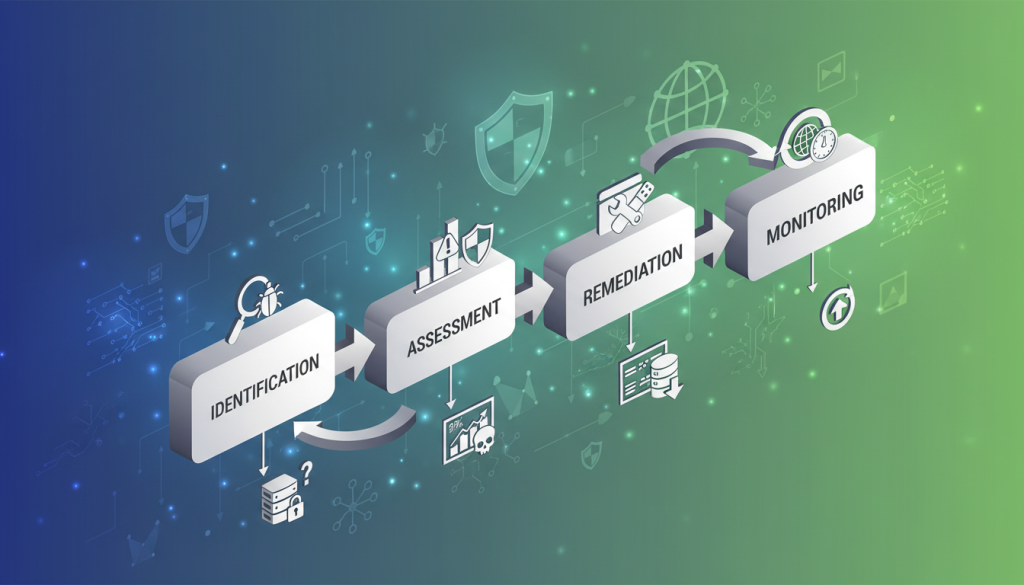
This continuous process identifies, assesses, and remediates weaknesses across your technology environment. We help teams prioritize efforts based on business impact.
Proactive Vulnerability Scanning and Assessment
Regular scanning uncovers vulnerabilities in software, network configurations, and application settings. Authenticated scans provide deeper visibility into internal systems.
Assessment determines which flaws pose the greatest risk. We evaluate exploit likelihood and potential business disruption.
| Priority Level | Criteria | Response Timeline |
|---|---|---|
| Critical | Public exploits available, affects critical systems | 24-48 hours |
| High | Easy exploitation, significant business impact | 3-7 days |
| Medium | Moderate difficulty, limited impact | 30 days |
| Low | Difficult exploitation, minimal impact | Next update cycle |
Remediation, Patching, and Software Updates
Timely patching addresses known vulnerabilities before exploitation. Configuration changes and strong passwords provide additional protection layers.
Regular software updates are essential for reducing risk. They eliminate known security gaps that attackers frequently target.
“Consistent vulnerability management reduces attack surface by addressing weaknesses before they become incidents.”
This proactive approach to vulnerability management ensures your network and application defenses remain current against evolving threats.
Threat Intelligence and Mitigation Tactics>
Effective protection strategies depend on understanding not just what vulnerabilities exist, but which malicious actors are most likely to exploit them. We help organizations distinguish between theoretical dangers and actual imminent threats targeting their specific environment.
Continuous Monitoring and Analysis
Continuous monitoring provides critical context about adversary capabilities and motivations. This approach enables security teams to prioritize defensive resources effectively.
We employ two complementary analysis methodologies. Tactics, Techniques, and Procedures (TTPs) examination offers qualitative insights into how cybercriminals operate. The ATT&CK Framework provides quantitative metrics for data-driven prioritization.
Understanding different threat types helps tailor defensive strategies. These range from sophisticated nation-state attacks to organizational data theft and individual targeting. Specialized intelligence teams continuously identify emerging threats and share actionable information.
This intelligence-driven mitigation transforms generic protections into targeted countermeasures. It ensures security measures remain effective as adversary approaches evolve.
Conclusion>
The journey toward comprehensive organizational protection begins with clarity about how different security elements interact and influence each other. We believe that mastering these fundamental relationships empowers teams to build more resilient defenses.
Effective security management requires balancing proactive measures with responsive strategies. This approach minimizes potential loss while maintaining business continuity. Each organization must tailor its approach based on unique assets and exposure levels.
Continuous improvement remains essential as technology and threats evolve. Documentation and learning from past events strengthen future protection efforts. For deeper insights into these critical concepts, explore our comprehensive guide on understanding risk, threat, and vulnerability relationships.
We stand ready to partner with your team in developing customized security strategies that address your specific operational needs and risk profile.
FAQ
What is the main difference between a threat, a vulnerability, and a risk?
A vulnerability is a weakness in a system, like outdated software. A threat is an actor or event that can exploit that weakness, such as a hacker. Risk is the potential for loss or damage when a threat successfully exploits a vulnerability. We help organizations manage all three components.
How does risk management reduce potential impact on my business?
Effective risk management involves identifying potential losses and implementing controls to lower their probability. By assessing the likelihood of an attack and its potential impact, we can prioritize mitigation measures to protect critical assets and reduce harm to your operations.
Why is vulnerability management crucial for network security?
Unpatched software flaws are a primary entry point for attacks. Our vulnerability management process includes continuous scanning to find these weaknesses. We then apply patches and updates to prevent exploitation, securing your applications and data from known threats.
What role does threat intelligence play in cybersecurity?
Threat intelligence involves continuous monitoring and analysis of the cyber landscape. We track malicious actors and their tactics to anticipate attacks. This proactive approach allows us to strengthen defenses before an exploit occurs, protecting your information systems.
Can you explain how these concepts work together using a real-world example?
Consider the MOVEit Transfer software flaw. The vulnerability was a weakness in the code. The threat was cybercriminals exploiting it to steal data. The risk was the significant financial and reputational damage to affected organizations. Our approach addresses each element to prevent such incidents.